Tuesday, June 3, 2014

A bountiful walk


In need of basil to make pesto, I took a basket, some snippers and walked out to the greenhouse. On my way, I passed Ralph's vegetable garden where I noticed some ripe tomatoes so I picked them and put them in the bottom of the basket.

A little further along by the barn, I was greeted by a scattering of Rudbeckia hirta, bright black-eyed Susan blooms. Some were streaked with brown while the petals on others were pure yellow.  How I love their cheery appearance.


I hadn't been in the greenhouse for several days.  It's generally Ralph's domain, although I'm always welcome especially if I want to weed. Weeds were lush, so I pulled quite a few before settling in to gather the basil leaves I had come for.  Before leaving, I also picked some cherry tomatoes and one huge ripe red pepper.  Nice surprises.

On the way back home, I stopped to take a few pictures of some persimmons, which are growing bigger although far from ready to pick.


Persimmons will turn orange in late September when they're ripe 


By the lake, a clump of Blue Timber Bamboo (Bambusa chungii) caught my eye.  I can't believe how huge it has gotten over the years.  I think we planted it in 2007.  Over that time, its grown into such a thick, tight clump, you'd never know it started out as two separate 3-gallon plants spaced 6-feet apart.  When it was first planted, each plant only had one or two canes.  To say they have a lot more now would be stating the obvious.


You can estimate how tall the bamboo is by comparing it to the two chairs on the left 


New Blue Timber Bamboo shoots began to appear in April and will continue to do so now through early November.  What a spectacular plant!


It only takes 45 days for new shoots like the one on the left to grow as tall or taller than the existing canes.  Bamboo is so amazing!


My walk out to the greenhouse for a few basil leaves turned into a mini-excursion.  I not only returned home with a basket of herbs and vegetables, I fed my senses with beautiful blooms, lovely plants and interesting observation of nature at work.  It was a bountiful walk indeed.


I'm not the only one who appreciates Rudbeckia blooms.  Seems like this hungry grasshopper does too.

Monday, June 2, 2014

Have bird nests gone mobile?


“Why do you have all those dried leaves in the back of the car?” my husband Ralph asked as we turned off our dirt road on the way to Mount Dora.

I was driving our Honda Fit with Ralph sitting as he usually does — not next to me like a normal passenger — but with his back against the front passenger seat, lounging comfortably as he faced rearward. This atypical vantage point enables him to stretch out and ease his restless legs while providing a clear view out the rear windows. It also allows him to see everything inside the car behind the front seats.

Since I was unable to see in the back, I responded as any long-married wife might with an impatient grumble, “What are you talking about?”

“The leaves,” he repeated, as if those words alone clarified the matter, “In the car.”

Since the road wasn’t busy, and I was perplexed, I chanced a look back toward the cubby beneath the right rear window where he was pointing. It only took one glance.


The cubby in our Honda Fit stuffed with dried leaves and sticks


 “The birds!” I said with alarm. “They must have built a nest in the car while the garage doors were open. Check and see if there are any eggs in there!”

As I frantically looked for a place to pull over, Ralph reassured me that stopping wasn’t necessary.

“It’s OK,” he said. “No eggs. No birds. Just a bunch of leaves stuffed in the cubby.”

I quickly realized what had happened. Years ago when we built our house, we designed our attached garage as a ‘drive-through’ space with two separate doors. Drive in one end, drive out the other. Very efficient and convenient except for one tiny flaw. Because of double openings, we must remember to shut twice as many doors. This minor detail becomes a major issue during bird-nesting season.


Double-entry garage doors...Drive in one side...

...Drive out the other

Over the years, numerous birds have escaped the elements by raising families in our oft-left-open double-door garage. At one time or another, mourning doves, screech owls and Carolina wrens have all taken advantage of our patent forgetfulness and built cozy nests within those walls.

Doves nested on top of the garage door opener mechanism in 2006 and again in 2007
In 2012, a pair of Carolina wrens built their nest on a shelf in the garage 


The first few times it happened, I was thrilled. What could be better, I thought, than having a ‘birds-eye view’ of the nesting process? Nature literally came to my door. Without even leaving the house, I could watch baby birds go from eggs to fledglings. Perfect!

Not quite.

As I soon learned, in addition to watching baby birds hatch, I could also watch baby birds die, eaten alive by hungry snakes. One entire brood of wrens met that sorry fate. I was devastated. While I understand all animals have to eat, it was still upsetting to accept the demise of those feathered cuties.


The rat snake that ate the baby Caroline wrens in 2012


Another lesson learned from those early experiences was how much waste a family of birds can generate during the rather brief nesting season. (In case you’re wondering, the answer is copious amounts.) Where those messy deposits land depends on whether you’re foolish enough actually to park your car inside said garage. Either way, expect constant splatters. Although I tried hard not to disturb the nesting birds, they shared no similar compunction. Bird-droppings on the car roof? Sure, why not? How about the windows? Yeah, there too.

Returning to the situation at hand, I realized not only had we left the garage doors open rather consistently recently, I often left car windows ajar, too. Open garage + Open windows = Open invitation. With mobile all the trend these days, apparently a pair of Carolina wrens decided to get in on the action. Fortunately, their efforts were thwarted before eggs were laid.


Carolina wrens are known for building nests in unusual places


As I drove on toward Mount Dora, I mentally replayed the conversation we just had.

“Ralph,” I asked, “when you saw the sticks and leaves tucked in the cubby and asked if I’d put them there, what did you imagine I intended to do with them?”

With nary a pause he answered, “I thought maybe you’d collected them to make a dried flower arrangement.”

I took another glance backward. A dried flower arrangement out of a mess of tan oak and bamboo leaves stuffed into a cubby — interesting conclusion. We may be married for more than 40 years but anyone who thinks marriages get dull over time obviously hasn’t spent time around us.

Sunday, June 1, 2014

A cereus surprise


According to Wikipedia, Selenicereus grandiflorus is a cactus species originating from the Antilles, Mexico and Central America commonly referred to as Nightblooming Cereus, Queen of the Night, Large-Flowered Cactus, Sweet-Scented Cactus or Vanilla Cactus.

According to me, it's simply a 'cereusly' grand surprise.

I received my Night-blooming Cereus two years ago as one of many plants offered at a Garden Web plant swap in Winter Garden.  I knew what it was because my daughter, Jenny, has a lovely cereus growing in a container at her home in Florence, MA.  I took the plant because I liked the idea of having one too.

However, I'm ashamed to say, I was not a good caretaker.  After I took the cutting home from the plant swap I basically ignored it.  I gave it no attention at all.  For two entire years!

When I say I ignored it, that means I didn't even plant the foot-long snippet I was given.  Instead, I let it lay around in an empty landscape pot in a corner of the garden.  If it rained, it got wet.  If it didn't rain, the cutting sat there without added water.  Occasionally I'd pass by and notice that it was still alive.  Remarkably, the long, flat leaves remained green with stringy roots that seemed to grow longer over time.

About a week ago, I passed it again and noticed something different.  A stem had emerged near the end of one leaf that bore all the markings of a future flower.  Suddenly, I was inspired. Sort of.

I took the cutting out of the landscape pot and stood it upright inside an existing planter that contained an unruly ice plant, a caladium and some red tasselweeds.  I didn't actually dig it into the soil.  I merely (lazily) positioning it in such a way that its future bloom would be visible from inside my bedroom window.

Two days later, I woke up at 6 A.M. to a cereus surprise:

What a beauty!

As the sun rose, I took more pictures

A close up look at the rare bloom


The Night-blooming Cereus remained open for several hours after sunrise

Now that the blooming is over, I will have to wait another year for a repeat performance.  That's fine with me.  I ignored the epiphyte for two years and it still rewarded me with a solitary bloom.  Plants don't get more generous than that! 

(BTW, I'll soon be transferring it to its own container with real soil and everything.  After two years of being ignored, I think it deserves a little attention.)  


Saturday, May 31, 2014

A two turtle day

I took back roads home from town today hoping, as I always do, to see something interesting along the way.  I wasn't disappointed.

My first find was on Scrub Jay Lane in Minneola, a road where I almost always see Florida's endemic (only found in Florida) bird, the Florida scrub jay.  Although no scrub jays caught my eye this time, I did see a gopher tortoise walking along the edge of the road.


After pulling over to take pictures, I moved on hoping that the hard-shelled reptile would have a safe journey to wherever it was headed.

A few miles farther along as I was driving along the clay stretch of Libby Number 3 Road, I encountered turtle number 2.

A very large softshell turtle was busy laying eggs.  She was almost completely covered with red clay with only her long neck stretched out as if she was searching to see if I would cause her harm.


Of course, I never would, but I have to say, the place she chose to lay her eggs was not the best spot. It was along the edge of the clay road where any driver who wasn't paying attention could easily run over either the turtle, her eggs or any baby turtles that might manage to hatch.

As I was leaving the spot where the turtle lay, another car approached from the opposite direction.  I rolled down my window and told them to be careful because a turtle was laying eggs up ahead. Fortunately, they seemed truly interested, pausing long enough to watch the clay-covered animal before they too moved along.


Tomorrow I have to go to town again and I'll be driving on the same two roads.  While normally I'd be looking for wildlife to see, tomorrow will be different.  I'll be hoping not to see something.  I don't want to see any sign that either reptile came to harm.  If that's what happens, I'll be glad.

Monday, May 26, 2014

Blackberry pie for breakfast?

It's a bumper year for blackberries.


Blackberries grow wild on our property in thorny thickets along pathways around the lake and along the edge of wetlands. Although I love most fruit, blackberries have never excited me.

Until this year.

"Have you tasted the blackberries yet?" I asked my husband after returning home from a walk. "They're so good this year, much juicier and bigger than usual."

All the rain we had in May along with warming weather has provided the plants with ideal growing conditions. In Central Florida, blackberries usually ripen in late May to early June when there many other edibles are also available. Blueberries are still bearing during that period and the limbs of peach, plum and nectarine trees bend heavy with fruit. Although mulberry season is mostly over by the time blackberries are ready to pick, there are still enough mulberries on the trees to add to mix with yogurt or add to a fruit salad. If I had to choose between picking blackberries and any of the other fruits, blackberries would lose.


Peaches,plums and blueberries are also ready to harvest at the same time as blackberries


My mother-in-law felt differently. When we used to live on Cape Cod, she couldn't wait for the seedy berries to ripen so she could make quantities of jelly and tasty pies (her secret: lots of sugar…). While I enjoyed eating her pastries and spreading jam on slices of bread, I never shared her enthusiasm for blackberries. Until this year, my consumption of the normally tart, seedy fruit was limited to a few berries picked while walking around the lake. Even then, my munching was accompanied by muttered grumbles because no matter how well I cover up, I can't seem to pick without staining clothing and scarring skin with splinters and scratches.

Picking blackberries is not exactly my idea of fun.


Blackberry thorns...Ouch!

  
This year, however, the reward/penalty equation has shifted. For the first time ever, the benefits of picking the wild berries might just outweigh the disadvantages. This year, the fruit growing on our property are sweet, juicy and plump instead of tart, dry and small. As I take walks, I find myself grabbing a handful despite snagging my sleeve on thorns and staining my fingers with sticky purple juice. I've even considered (although I haven't done it yet) going out to pick a bucketful with the intention of making a blackberry pie, sweetened with stevia instead of sugar.

My hesitation lies in the fact that blackberries might just be one of nature's most well-protected foods. On our property, they grow in thickets, a good word to describe the dense mounds of tall, bendy fruit-bearing canes covered with an abundance of sharp thorns. The thorns have no difficulty piercing skin and skewer cloth with ease. As if that wasn't enough, the leaves of wild blackberries have a rough, scratchy underside peppered with what feels like prickly needles. When hands touch leaves, as they inevitably do in the plucking process, tiny splinters work their way under the skin.


Jenny and Toby brave thorns and prickers to pick a couple bowls of blackberries in 2006


Wildlife is also fond of the thorny plants. Rabbits and other small animals take refuge in the brambles while the fruit is an important part of the diet for black bears, raccoons, squirrels and birds. In addition to also eating berries, some birds build nests in the dense thickets while in early spring the white flowers attract nectar-seeking bees, butterflies and moths.


Dense blackberry thickets provide wildlife with food as well as safe nesting and hiding space 


I'm glad our property is dotted with blackberry plants even if I don't take full advantage of the bounty. It's good to know they're there, feeding birds, insects and animals, providing nesting sites and shelter. And who knows, maybe this will be the year when I actually brave the barbs, the stains and shredded clothing to pick a bucketful of berries and make a pie.


Hmm … blackberry pie for breakfast. It does sound tempting!

Monday, May 19, 2014

Springtime in New England


Ralph and I recently spent a week in New England. On the drive from the airport to our daughter Jenny’s home in Florence, Mass., I found myself fixated on the colorful landscape. Although I grew up in Pennsylvania and lived on Cape Cod for 17 years, it’s been a long time since I’ve experienced a northern spring.


Spring in New England (photo by Jenny Boas)


It was by happenstance that the timing of our trip coordinated with a flush of flowering plants, but what a stroke of luck! I was able to experience the bold bloom of forsythia bushes, the fragrant pink blossoms of crab apple trees and prolific displays of groundcovers such as violets, forget-me-nots and phlox. I was there to see tulips and lilies emerge from winter-weary ground. I saw fruit trees flower, maple leaves unfurl and everywhere I looked, I watched weeds grow at an alarming rate.


Maple leaves opened during our visit


Dandelions, that bane of many a residential landscape, were ubiquitous. The large yellow blooms dotted small yards and vast fields alike. Although I’m sure many people struggle to eradicate the invasive wildflowers from their lawns, every now and then you come across individuals who look at dandelions and see opportunity.


Dandelions everywhere!


On Mother’s Day, on our way back from a birding walk, Jenny and I passed a group of children and adults gathered in a field overtaken by the yellow-flowering plants. A photographer kneeling next to her tripod was taking a family portrait. As we drove by, I smiled to think how treasured that beautiful scene — a family encircled by gold — would be in years to come. The timing was perfect. A few days later, that same field was covered with dandelion seed heads, those feathery orbs of far-flying seeds attached to wispy parachutes. It’s no wonder the common dandelion is… well, so common in New England.

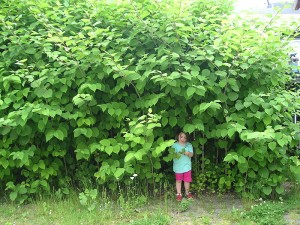
Another omnipresent weed that I watched emerge during the week we spent in Florence was Polygonum cuspidatum, better known as Japanese knotweed. 


Knotweeds emerging alongside a daylily

When Jenny and her husband Brett bought their house last year, their entire eastern border was covered in dense stands of towering knotweed. My husband worked hard last October to chop down and dig up the aggressive perennial but, despite his valiant efforts, new plants began poking through the ground this spring shortly after we arrived. By the time we left seven days later, numerous shoots were already leafing out, three-feet tall and growing taller.


If left alone, this is what knotweed can look like (photo by eattheinvaders.org)


As I watched the knotweed surge madly skyward, I couldn’t help but feel glad it doesn’t grow in Florida. I had the same thought as I noticed all the tiny maple trees popping up in garden beds and onion grass invading lawns.

Experiencing springtime in New England was a fortuitous bonus for a pair of grandparents whose trip was planned around spending time with family. I enjoyed taking walks in the cooler air, seeing daffodils and watching lilacs develop. I loved the color of ornamental quince flowers — a reddish, coral I’ve rarely seen in nature — and finding mounds of swamp cabbage in wetlands. 


Ornamental quince

But mostly I found myself feeling grateful to be visiting only. As much as I enjoyed a week-long taste of a northern spring, I was eager to return home to the ever-changing southern seasons I have come to love so much.

When we told one New Englander we lived in Florida, his response was, “What’s it like there now, 130-degrees?”

Florida may not be everyone’s idea of paradise, but it’s mine. Although we were away for just short time, it sure is good to be home.

Thursday, May 15, 2014

Garter snake show-and-tell provides surprising lesson

When I spotted a harmless garter snake during a recent visit with our daughter and twin grandchildren, my husband (literally) seized the opportunity to do a little hands-on educating. Lessons were definitely learned, but maybe not quite the ones he intended.


Monday, May 12, 2014

May is a berry sweet Month

It’s May, one of the best months to be outside. Some people take advantage of the pleasant weather to work in the garden, play golf or stroll around the neighborhood. For Ralph and me, May is a month to head over to Lake Catherine Blueberries in Groveland to pick a couple buckets of one of our favorite fruits.


Another year of picking blueberries together

Picking blueberries was a family tradition well before we moved to Florida. When we lived on Cape Cod, we would go to a blueberry farm in Eastham at the end of summer — rather than now as we do in Florida — because that’s when blueberries ripen in New England. After relocating here, we had to reset our u-pick clock since blueberry season starts early in the spring and ends between June and July, depending on the variety and location.


Mm...mm, good!


Our first Florida residence was in Kissimmee and although the closest u-pick farm was several hours away, that didn’t stop us from piling our young children into the camper every spring to drive north to Marion County, where we’d pick buckets of fruit from the backyard farm of an elderly couple in the community of Moss Bluff.

Our trips to Moss Bluff were an annual event for several years. On each occasion, we’d pick all day long, trying to get enough fruit to last the winter, then reward ourselves with big bowls of homemade blueberry ice cream that the couple sold out of a chest freezer by their house. Sometimes we’d stay overnight, camping in the couple’s field. We’d always take a swim in a secluded lake before the long drive back to Kissimmee.


Our freezer filled with bags of blueberries

Shortly after moving to Groveland in 1992, we were pleased to discover that our new home was less than 10 miles away from Mark’sBlueberries. At the time, Mark’s was one of the few u-pick blueberry farms in Central Florida. I can’t begin to calculate how many hundreds — maybe thousands — of pounds of blueberries we picked there over the years. To say we were regulars would be an understatement. We didn’t just pick fruit at Mark’s — we made memories.


Ralph and our youngest son, Toby, picking (and eating) blueberries at Mark's in 2005


These days, blueberry farming is on the rise in the Sunshine State, so more families can create memorable experiences like those we’ve enjoyed over the years. The Florida Blueberry Growers Association, which launched in 2012 with just 25 members, has 350 members today. Instead of just one farm to serve an entire region, there are now more than a dozen u-pick blueberry farms in the Greater Orlando area, including at least 10 locations (listed below) throughout Lake County.

One of the newer Lake County u-pick operations is just five miles away from our home. Lake Catherine Blueberries is located a mile north of State Road 50 on State Road 19. Longtime citrus farmers Clinton and Ann Lowe together with their son Dustin and his wife Jamie Godfrey Lowe, planted their first blueberry bushes in 2009 on five acres of pasture land.


The Lowe Family

When that modest start proved successful, they planted more. By 2013, blueberries were growing on 17 acres, and this year they have a total of 37 acres in production. Plans for 2015 include two additional acres allocated for u-pick blackberries.

Our family has been picking fruit at Lake Catherine Blueberries ever since they opened. As I’ve watched the farm grow, I’ve been impressed by how much hard work and effort the family has put into creating a top-notch operation with a broad online presence. The Lowes have accomplished what few agricultural enterprises can do — they’ve turned a u-pick farm into a community destination.


Our four grandchildren all enjoy picking blueberries
Above: Atom and Trillian


In addition to blueberry picking, visitors can purchase blueberry-themed items and homemade goodies at Ava Grace’s Country Store or quench their thirst with a glass at D.J.’s Lemonade Stand, both named after Jamie and Dustin’s young daughter and son. There’s a playground for the kids, a cutout poster to pose in for pictures and an antique tractor to admire. Groups can arrange for a tour, which includes an education overview of what farming is all about, berry sampling and a hayride.


After three decades of picking blueberries, I’ve come to realize that there’s more to picking fruit than the berries themselves. An important part of any retail experience is the way you are treated and the feelings you get from the location itself. I’m glad to know that the people who own and operate our local u-pick blueberry farms are doing their best to make the public welcome.

If you have not yet visited a local berry farm, go soon. Not only will you be filling a bucket, you’ll be gathering memories to savor long after blueberry season ends.


Some of the U-Pick Blueberry Farms in Lake County:

A Natural Farm, 23630 SR 19, Howey in the Hills; 352-536-3112

Blue Bayou Farms (organic), 26921 Bloomfield Ave., Yalaha (next to the Yalaha Bakery); 352-324-4069.

Blueberry Hill Farm (organic), 5000 Berry Groves Road, Clermont; 864-944-1401.

Green Acres, 8563 High St., Yalaha; 352-360-5445; blueberries and peaches.

H&H Berry Farms, 15217 County Road 455, Montverde; 321-436-5830: You-pick and already picked.

Heather Oaks Farm, 4240 Christmas Lane, Lady Lake; 352-753-1184: Other produce as well.

Lake Catherine Blueberries, 5849 Lake Catherine Road, Groveland; 352-551-4110.

Mark's U-Pick Blueberries, 18900 County Road 561, Clermont; 352-394-2135.

Sand Hill Farm, 31614 Bottany Wood Drive, Eustis; 352-636-8204.

Southern Hill Farms, 16651 Schofield Rd., Clermont; 321-239-3137. 

Monday, May 5, 2014

Mother's Day thoughts...

With Mother’s Day just six days away, many folks are focused on what gift to buy, what card to send and how best to express heartfelt emotions. While those are understandably relevant questions and concerns, my thoughts keep wandering to different kinds of mothers.

At our lake, a soon-to-be-mother sandhill crane is sitting on eggs. Each morning, I look through the binoculars to make sure she’s still there. She always is. It doesn’t matter if it’s hot and dry or pouring down rain, foggy mist or sunny morn. Sandhill crane mothers are innately patient, persistent and protective of their future brood.


The sandhill crane nest is a soft bundle of lake weeds set upon a small tuft of grass about 30 feet off the shoreline. Although the male crane is often away during the day, he returns every evening to spend nights by her side (sandhill cranes are monogamous and mate for life). Once the eggs hatch — about a week after Mother’s Day — the pair will raise their young together. I’ve watched sandhill cranes raise babies before and have always been impressed by how seriously these magnificent birds take the task of parental responsibility.


Not far from where the cranes are nesting, a female downy woodpecker is carving out a home near the top of a dead slash pine. I came upon the nest-building bird a couple days ago, but excavation must have begun several days earlier. As I watched from the base of the tree, the bird diligently drilled away at the hole. She exhibited steady effort, pausing only to survey her surroundings for potential threats.


On the day I discovered the downy woodpecker, the hole she had made was only large enough to fit the front half of her body. However, by the following day, the entire bird could disappear within. So much labor went into the creation of a home for future offspring. Although male and female downy woodpeckers typically build nests together, I saw only the female working on this one. The male was nearby, but she was the one pecking away at the wood.


When excavation is complete — a job that can take up to two weeks — the female will lay a clutch of three to eight eggs. At that point, the father steps in to do the majority of incubating. I always find it intriguing how differently nature divvies up parenting chores. In some species, females do all the work. In others, it’s the male. Often both parents share the responsibilities of bringing children into the world.

When the downy woodpecker eggs hatch, both parents will struggle to feed their brood. Yet, despite their best efforts, only one or two of their babies will survive. That often happens with baby sandhill cranes, too. The mother crane usually lays two eggs, but only one chick tends to survive. I can’t help but wonder if they feel sad.


The third parent I’ve been thinking of lately is another woodpecker. A family of pileated woodpeckers lives in a dead slash pine across the lake from my home. Several weeks ago, I noticed several large holes drilled in a snag and shortly after, saw a male pileated woodpecker land on the tree before entering the hole. Although I assumed the birds were nesting within, I didn’t know for sure until I chanced upon a magical moment a few days ago.


As I was setting up my tripod in the forest in the late afternoon, a female pileated woodpecker flew to the snag. As I watched through my camera, two red-topped heads appeared as their mother approached.


Although I don’t pretend to speak bird, unmistakable cries of “Feed me!” filled the air. Mama bird did her best to satisfy the baby birds’ demands. Nonetheless, one offspring craved more. How do I know? I saw the baby bird peck his mother in the chest with his not-so-tiny beak. Yet, despite his rude and perhaps painful reproach, mother bird did nothing more than reposition herself. She neither erupted in anger as I’ve seen human parents do, nor did she retaliate or disappear. She simply moved out of his way.


You don’t have to look far to see examples of what it means to be a good mom. You don’t need a special gift, card or sentiment to express the wonder that is a mother’s love. Mother’s Day may be around the corner but in nature, lessons in mothering go on every day.