Showing posts with label coyote. Show all posts

Saturday, July 9, 2016

Coyote on the move

A short clip of a healthy looking coyote who noticed me before I noticed him.  I was out in my rowboat on the lake.  He was walking along the path through the forest.


After staring at each other for a few moments, the coyote decided to move along.  I grabbed my camera and managed to catch this short video of the tawny-furred mammal before it disappeared into the forest.


Friday, April 29, 2016

Coyote eating mulberries

During the last week in April this female coyote has been coming out of the woods in the mid-afternoon to eat black and white mulberries that have fallen to the ground beneath our mulberry trees.


Each day, the coyote - a nursing female - has ventured a little farther away from the woods.  I took this video while she was eating mulberries from the tree closest to our house - a very brazen act for a normally shy animal.


Monday, March 30, 2015

Coyote sighting

I was about to turn off the country lane onto busy State Road 19 when a coyote ran across the road in front of me.

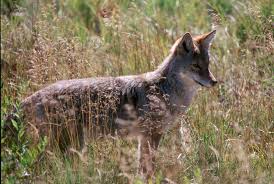
Instead of continuing on my way, I pulled over and looked in the direction where the animal had gone until I spotted him in the brambly woods. The tawny-furred predator was standing still — watching me watch him. The coyote blended in so well with his surroundings that I missed seeing him move when he decided to leave, even though I was looking directly at him.


I couldn’t stop looking at the spot after the coyote left. I sat in the car and scanned the woods to see if I could find any other coyotes in the area. Although Canis latrans, which means “barking dog,” doesn’t run in packs like wolves do, the fleet-footed canine occasionally does travel in small family groups.

If there were other coyotes in the area, I didn’t see them. After a couple more minutes of intensified looking, I decided to turn south on S.R. 19 and continue on my way.

Coyotes are closely related to domesticated dogs, but they’re a far cry from “man’s best friend.” Pet owners fear the omnivorous predators will eat their beloved dog or cat. Ranchers dislike them because they sometimes kill livestock, and farmers don’t want them to eat their crops.

Many people detest coyotes but I’m not one of them. I harbor no ill will toward these mammals that have managed to survive — even thrive — in our less-than-hospitable, human-directed world. Instead of feeling frightened, alarmed or angered by a coyote’s presence, I consider any encounter I have with a large wild animal to be a gift.

Coyotes are smart. They’re extraordinarily adaptable and clever. They form strong family groups and protect their young. Although coyotes act and look like dogs — they’re usually grayish-brown, between 20 and 30 pounds with pointy ears, a narrow muzzle and a bushy tail — they receive none of the respect we lavish so willingly on their domesticated cousins. It’s odd how one animal is abhorred while the other is universally adored.

This was not the first time I’ve seen a coyote in the rural area I consider my neighborhood, and I doubt if it will be the last. Late winter is a coyote’s reproductive season with new pups born in spring. I don’t know where the coyote I saw was going or what it was after, but there’s a good possibility it was looking for food to take back to its mate or young offspring.

With Florida’s open hunting season for coyotes and the ever-present risk of being killed by a vehicle, the chance of survival for any individual animal is small. Yet, despite all the odds against it and an abysmal lack of public support, coyotes still manage to secure a place in our human-centric society. While other wild mammals fail to thrive, the much-maligned coyote doggedly endures.

Sunday, January 4, 2015

Coyote sighting!

I'm sitting in the kitchen reading.

A coyote wanders by.

Fortunately, my camera is close at hand.

Unfortunately, the coyote moves much faster than my excited hands can manipulate the camera's settings.
 
I snap off a few shots.  The first one - where I have the closest, clearest view - comes out blurry.


What a thrill!


The coyote moves off behind the mulberry trees.  I take more pictures.


A coyote, obscured by the bare branches of a mulberry tree


The coyote spots my husband working in the garden and, for a moment, stands still.  Then he takes off through the woods.  By then I'm outside but the animal has moved too deep into the forest to follow.


A coyote eyes my husband before darting off into the woods

Nonetheless, I'm elated.  I saw a coyote today, just outside the kitchen window!

Sunday, October 23, 2011

Coyote by the side of the road

The coyote is a close relative to the domesticated dog but relies on its own wits and hunting skills to find food.


Simply Living
October 23, 2011

On my way to town, I saw a dead coyote. A wave of sadness washed over me as I drove by. I wondered if the animal was male or female. If it was a female, did she leave a litter of pups? If the animal I saw had pups, would they be old enough to survive on their own?

Coyotes give birth to an average of six babies, though depending on conditions, a litter can be as small as one or as large as 19. The pups are blind for their first two weeks and don't accompany their mother on hunts until they are 6 to 10 weeks old. After a year, coyotes become sexually mature, and they mate for life. If the coyote I saw had a partner, its mate was suddenly alone.

I realize that many people don't share my empathy for these wild members of the dog family. To them, large predatory animals such as coyotes pose a threat to the safety of humans and their pets, and that perceived danger justifies the animals' eradication. In their minds, the only good coyote (or alligator, bobcat or bear) is a dead one.

I feel differently. My heart goes out to all unfairly maligned critters — spiders and snakes included — struggling to survive in a human-dominated world.

Most wild creatures have it tough. People are constantly modifying animal habitat in the name of progress, often eliminating nesting grounds and natural food sources. Then, when the same animals whose homes and hunting grounds we've destroyed seek out alternative sources of food and shelter to survive, we victimize them for their efforts. We label them "dangerous" without bothering to understand who they are, what they are all about or how we may have contributed to the problem.

The coyote is a close relative of the domesticated dog. However, unlike pampered house pets whose human handlers present them with a daily diet, these 17- to 46-pound wild mammals must rely entirely on their own wits and hunting skills to find food for themselves and their offspring.

Mice, rats, squirrels and rabbits make up most of a coyote's diet, supplemented by fruits, insects, frogs and, at times, carrion. Occasionally coyotes — especially those with compromised hunting grounds — seek food in areas where farm animals or pets live. That's usually when problems arise.

Pet owners get scared if coyotes wander through a neighborhood, and ranchers feel threatened. That fear turns into rage if wild animals capture and eat livestock or attack a free-roaming house cat or small, unleashed dog. However, when a cat captures a songbird (often killing but not eating the bird), the typical pet-owner response is a resigned shrug, as if to say, "Ah, well, that's what cats do."

Pets receive a generous amount of leeway denied to wild animals such as coyotes.

I understand the sadness felt when a beloved pet dies unexpectedly. Years ago, an alligator ate our 13-year-old terrier, but the loss of the family pet to a hungry reptile didn't make me hate alligators. I knew that the 6-foot-long predator was only doing what alligators do: hunting for easy prey. We were aware at the time that an unusually aggressive gator was present in our lake, yet we thoughtlessly let our unleashed dog outside. It was our responsibility as pet owners to have better monitored his whereabouts.

In the wild, a coyote has a life span of 10 to 14 years, but just over 20 percent make it to adulthood. October or November is when most pups are mature enough to forage on their own, but those young, inexperienced animals are especially vulnerable. A car apparently hit the coyote I saw. I'll never know if it was a young adult just starting or a mature animal that left behind a mate and family.

Although the sight of the dead coyote by the roadside saddened me, in general, I'm encouraged by the species' success rate. Rather than decreasing amid the loss of wilderness area, populations have grown. Like their domesticated canine cousins, coyotes are adaptable animals. They have learned to forage for food and find shelter in suburban and even urban settings. Unfortunately, not all have learned to avoid cars.

It's hard enough for people to survive in the complicated world we've created, but it's more difficult for wild animals that must adapt. I passed a coyote the other day that didn't make it, but I'm hoping its family will survive.

SIDEBAR
For more information about coyotes, check out this Project Coyote, which, according to their website, "creates innovative solutions that foster peaceful coexistence between people and coyotes. We champion progressive management policies that reduce the number of human-coyote conflicts and the number of coyotes destroyed. We believe that, as North America’s native wild "song dog", coyotes are a vital component of our rural and urban communities, deserving respect for their adaptability, resilience, and intelligence."

Monday, August 18, 2008

New appreciation of life ascends 13 steps up the clay wall


Simply Living

(First appeared in Orlando Sentinel August 18, 2008)

When we built our house 16 years ago, the spot we selected was on the slope of a steep hill.

The soil was thick orange clay, and to create a road to the garage, we had to cut away some of the hill and terrace the land into a series of steps. The result was a stark clay wall about seven yards behind the house that leveled off about four feet before stepping up again for another short climb.

To reach the upper area, Ralph cut a 13-step stairway into the hard soil and smoothed it over with concrete. My office looks directly at those stairs and the narrow path above them.

Initially, the area we call "the clay wall" was raw and ugly, but after years of planting vines, shrubs and gingers at its base, the wall disappeared behind flower-studded greenery. Over time, the once-barren hillside became lush and verdant. Huge oaks now cover the sloping land, their long limbs reaching down to brush the leaf-littered ground.

It was in this relatively untended spot that, on two separate but equally thrilling occasions, I recently saw first a coyote and then a bobcat walk along the pathway at the top of the clay wall before pausing at the head of the steps.

When the coyote came, I was alone in my office working on the computer. Although my eyes were focused on the monitor, the animal's movement must have triggered an unconscious awareness, because I looked up just before the coyote reached the spot where the path meets the stairs.

I'm embarrassed to admit it was my own loud calls to my husband and son that scared the critter away. Apparently, even if a person is inside a building a good 25 feet from where a wary coyote pauses to survey the landscape, cries of "There's a coyote at the top of the stairs!" can be heard by the animal's finely tuned ears.

The tawny-toned hunter turned around in his tracks and scampered off into the woods -- but not until he looked directly at me with large, probing eyes as if to say, "What did you do that for?" How foolish I felt to have reacted in such a typically insensitive, loud human way.

In retrospect, I wish I had reached for my camera and snapped a few pictures to share instead of trying to call my family into the office to see the animal themselves.

Fortunately, when the bobcat came by a few days later, my 16-year-old son was already in the office with me. It was Toby, not me, who spotted the stubby-tailed predator. With a calm voice that wouldn't scare away a fly, Toby announced, "Look. A bobcat."

Sure enough, standing right where the coyote stood a few days before was a beautiful spotted wildcat. Like the coyote, the bobcat paused when the level path it was taking met the top of the stairs. It too chose that spot to sniff the air and survey its surroundings. I wasn't screaming this time, so it wasn't scared away. Assured of its safety, the bobcat ambled along the narrow, grassy path.

I wish I could say I snapped some wonderful photos of the animal as it stood at the head of the stairs surveying its surroundings. Unfortunately, I didn't.

Cameras, even close-at-hand digital devices, take time to turn on and get ready, and in that time the bobcat moved out of view. But I wasn't ready to give up. Toby and I, now joined by my husband, quickly stepped outside to see where the bobcat was heading.

It was heading directly toward us.

Even though we were making a concerted effort to stand still and be quiet, the animal's sharp ears and acute sense of smell noted our human presence almost immediately.

Like the coyote before him, the bobcat gave one long, final gaze at these pesky people before retreating rapidly into the dense wooded undercover.

These two recent sightings got me thinking. I've seen bobcats and coyotes before on the property -- not often, but frequently enough to know the land we live on is part of the territory they also call home. I also know that, despite being predators, both critters are not above foraging through compost piles for edible tidbits.

Putting two and two together, I decided to build a new compost pile at the top of the steps. Perhaps a depository of aromatic scraps would draw more animals to this spot of close observation.

It has been about a week since the compost pile was completed. Although the only wildlife I've seen so far has been squirrels and birds, I remain hopeful that someday a bobcat, fox or coyote will stop by to check it out.

My attitude about the clay wall has changed dramatically, especially since the coyote appeared. Sixteen years ago, what began as an eyesore has turned into an attractive -- if somewhat unkempt -- landscape feature. More recently, that same clay wall has become a focal point of both the yard and my imagination.

It doesn't take much to change our perspectives. From ugly to lovely, unkempt to well tended, small steps can make a big difference in our everyday world.

In my case, 13 small steps up a solid clay wall have made a big difference in my daily life. From an area once ignored to one much adored, my office view has become much amended.