Monday, February 27, 2012

One tree - many visitors

Zebra longwing butterflies are among the wildlife attracted to nectar-producing bottlebrush blooms.

Simply Living
February 27, 2012

A bouquet of bottlebrush blooms is sitting on my kitchen counter. The red, bristly flower spikes add a bit of brightness at a time of the year when most plants are just beginning to awaken from their winter rest.

A flurry of butterflies, hummingbirds and bees hovered over the pendulous blooms as I snipped a few flowers from low-hanging branches. The nectar-covered blossoms attract so much attention from the buzzing and fluttering crowd I had to be extra careful when making my selections, not to get in the way of any stinging insects.

The bottlebrush's long blooming season adds to its popularity among people as well as wildlife. Although this woody shrub is native to Australia, it thrives in Central and South Florida's warm climate growing in all but the most alkaline soils. It tolerates dry, moist and even salt spray locations. Although susceptible to freezes, bottlebrush recovers quickly. During the last four winters — three of which were unusually chilly — cold damage was limited and each of the trees recovered without affecting the next season's bloom.

Bottlebrushes are compact trees rarely exceeding 20 feet in height. Their diminutive size makes them a fine choice for small, tight spaces. Many people also choose them because of their weeping willow-like shape, but bottlebrushes have something willows don't have — flowers. For most of the year, the tree is adorned with 4- to 6-inch-long cylindrical flower spikes.

A bottlebrush's floral display is quite the sight. Bright red flowers dangle from the ends of each of the tree's many thin, swaying branches. From afar, the blooms — which really do resemble bristly brushes used to clean a bottle's narrow neck — look like one long tube-shaped flower. Actually, each spike is composed of many individual flowers. Sweet nectar — the calling card for butterflies, bees, wasps and birds — forms on the tips of red, needle-thin filaments along with yellow pollen, and every flower contains clusters of filaments. Whenever I gather the red blooms for a bouquet they sparkle with droplets of nectar.

About twice a year, I give my bottlebrush trees a trim, a process not unlike cutting hair. Using hand-held clippers, I do my best to even out unruly growth. My aim is to prune the hanging branches to form a straight line just above head height so I can walk under them easily. It's not a difficult task and only takes a few minutes. Trimming low-hanging branches is the only care we give our trees. We don't fertilize them or treat with chemicals. The two trees in our yard receive a bit of irrigation when the lawn is watered but the young saplings that sprung up on their own do just fine on rainwater alone.

A bottlebrush tree is in the genus Callistemon, one of 34 species in the same family as melaleuca trees. Melaleuca is on the Florida Exotic Pest Plant Council's list of highly invasive exotic plants (Category 1). The weeping bottlebrush tree (Callistemon viminalis), is listed as a Category 2 (less invasive) plant for South Florida but it is not considered an invasive species in the central part of the state. In the 15 years since we planted our two bottlebrush trees, only three volunteer saplings have appeared on our property.

In addition to colorful filaments, clusters of brown bead-like seeds form on each flower spike. When I'm out collecting plants for a dried flower bouquet, I often include a few seed clusters in the arrangement. The bottlebrush seeds can remain on the tree for years. Wildfires can cause the seeds to open and seed-eating birds help disperse them but the plant can also be propagated through softwood cuttings. Young trees are usually stocked by most nurseries and garden centers.

If you're looking for a hardy, low-maintenance ornamental to add to your landscape, consider a bottlebrush tree. It's not a Florida native plant but it certainly attracts native wildlife. One small tree will provide sustenance to countless birds, butterflies and bees with plenty of material left over for decorative indoor displays.

Monday, February 20, 2012

Soup's on!

A warm bowl of Butternut Squash soup topped with a dollop of cashew cream is delicious meal regardless of the weather Three basic ingredients are all that’s needed to make a satisfyingly tasty simple meal.

Simply Living
February 20, 2012

Hot soup is the perfect food for a cold day, but some soups are so tasty and easy to prepare they are a welcome meal in any weather. That's the case with Butternut Puree, one of many flavorful offerings at Karma, a restaurant in Northampton, Mass.

Our daughter and her family live in that quaint New England town and whenever we visit — frequently since the twins were born — we take advantage of the restaurant's tasty offerings. While every menu item we've tried has been yummy, Butternut Puree is the one we're most likely to reorder.

On its webpage (bekarma.com), the eatery says it "focuses on creating pure food that is delicious to the palette and beautiful to the eye." That's certainly true of Butternut Puree. Imagine a steaming bowl of saffron-colored smoothness, topped by swirls of creamy whiteness. Now balance the squash's natural sweetness with the slight pungency of caramelized onions, seasoned with a touch of curry and enhanced by the richness of cashew cream. Voila! No salt, greasy oil or sugar needed to make this simple soup delicious.

Since dining opportunities at Karma are limited to the times we travel north, I experimented at home to create an approximation of Karma's sublime offering. Happily, the formula I came up with is similar in taste and texture to the original. Butternut Puree — I call it Butternut Squash Soup — is a filling, flavorful and healthful meal. While low in calories (153 calories per two-cup serving), it is high in potassium and vitamins A and C. It is also extremely easy to prepare even though preparation is a two-step process, which means a bit of planning is involved.

Three basic ingredients:  Butternut squash, sweet onion, cashew butter


Ingredients: 1 large butternut squash (around 5 pounds); 1 large sweet onion; 1 tablespoon curry powder; 12 ounces tea, cooled; 1 teaspoon olive oil; 2 tablespoons unsalted cashew butter; about a tablespoon of water.

Planning: The day before you make the soup, brew up a pot of tea and set it aside to cool. Any tea will do but I'm partial to either a green tea (Prince of Peace Organic Jasmine Green Tea) or an herbal ginger blend (Tazo Organic Spicy Ginger). While the tea is brewing, preheat the oven to 400 degrees and cut the butternut squash in half lengthwise.

Butternut squash has a hard skin, so be sure to use a sharp knife and great care when slicing it lengthwise. After the squash is cut in half, scoop out the stringy strands of seeds and set them aside for later. Place the lengths of squash flat side down on a large cookie sheet and put in the oven, where it can bake for about an hour or until a knife poked through the skin comes out easily.

Once the squash has finished baking, let it cool for a couple hours until it is a comfortable temperature to handle. At that point, scoop out the orangey flesh, discard the skin and refrigerate the pulp until you are ready to make the soup.

Preparation: Peel, slice and sauté an onion in a teaspoon of olive oil until the slices are soft and transparent. Pour 12 ounces of tea into a food processor then add the squash pulp, sautéed onions and about a tablespoon of curry powder. Blend until smooth.

That's all it takes to make the soup. Now it just needs to be heated.

Heating and garnishing: Because its texture is thick, I use a double boiler to prevent burning but a microwave or careful warming directly on the stovetop is also effective. While the soup is warming, put the unsalted cashew butter (I use Artisana Raw Organic Cashew Butter purchased online through iherb.com) in a small bowl and add a few drops of water. Using the back of a spoon, blend the cashew butter with the water, gradually adding more drops and mixing until the texture becomes cream-like. Drizzle the cashew "cream" on top of the warm soup just before it is served.

(Savings hint:  Save $5 at iherb.com by entering code LEJ891 at checkout)

One 5-pound butternut squash makes eight servings of soup, enough to provide two people with warm, scrumptious meals for several days.

Bonus: Remember the squash seeds? Separate any strands of pulp from the seeds, then place them in a cast-iron pan, sprinkle with curry powder and roast on the stovetop over a low flame stirring often. After only a few minutes, the seeds start to dry out and soon become crispy. They make the perfect snack to munch upon before, during or after preparing the soup.

Monday, February 13, 2012

Thinking outside the store-bought box: 5 ways to express your love on Valentine's Day

A gift doesn’t have to be cost money to be meaningful. It can even be impermanent like these words in the sand and still have a lasting effect.

Simply Living
February 13, 2012

Tomorrow is Valentine's Day. If you haven't already done so, shop owners are hoping you'll come into their stores today and buy-buy-buy. As lovely as many store-bought presents are, spending cash isn't the only way to express love. A wealth of gifts awaits that special someone and the only thing needed to procure them is a little creativity.

Flowers — Flowers are a Valentine's Day staple and the sweet smell of roses, carnations or a fragrant orchid can linger long after the blooms fade. But don't forget, flowers grow in earth, not in a florist's cooler. Consider taking a walk around your own yard to pick a bouquet of your own making. If you notice a particularly pretty or sweet-smelling bloom in a neighbor's garden, knock on their door and ask permission to pick one or two. Most likely, they'll say yes. Not only will you return home with a floral display that is uniquely yours to give, you will also have given a second gift to your green-thumbed neighbor. Your appreciation of their garden will make them smile for many days to come.

Sweets — Is any gift sweeter than chocolate or candy? How about a treat from your own kitchen? It doesn't take long to whip up a cake, sweetbread, muffins, a tray of cookies or a plate of chocolate-dipped strawberries. These days, the Internet makes it easy, even if your baking experience is next to zero. Actually, inexperience is a plus in this case because the recipient of your efforts will know you took extra effort to make them something special. For step-by-step help creating that perfect dessert, check out YouTube videos as well as online recipe websites.

Pampering — We can all use a bit of pampering and a trip to the spa is a wonderful way to tell your love interest how much you care about their overall well-being. But massage sessions can be pricey, especially on a limited budget. Fortunately, you don't need to schedule an appointment or spend any cash when you create a spa in your own home. The only things needed for this gift is the willingness to turn off the phones for an hour, dim the lights, put on some soothing music and focus on your partner. Brushing your loved one's hair may not be a normal part of a massage treatment but it can be a wonderful way to pamper your partner and pampering is what this gift is all about. Remember, you don't need strong hands or expensive oils to give a massage. Soft strokes, light scratches or gentle tickling all go a long way to demonstrating your loving touch.

Honey-do list — We've all got them: long lists of chores that need to be done. Taking it upon yourself to do one or two of the most demanding tasks without being asked (that's the key ingredient here) can result in benefits store-bought presents may never realize. Cleaning out an unkempt closet, painting a wall, weeding a garden, unclogging the gutters or vacuuming the house may not seem like the most romantic offering but be forewarned: Doing these chores can result in unexpected displays of gratitude.  Make sure the bed is made if you decide to go with this Valentine's Day suggestion because there's a good chance you'll be landing on it in a romantic way by the end of the day.

Time out — Is there any better way to express your affection for the most important person in your life than to provide them with your undivided attention? Taking time out of your busy day doesn't cost a penny but it pays back in dividends that last forever. On Valentine's Day — on any day of your choosing — take time, make time, for your special someone. You don't have to do much. You can stay home and watch a movie. You can go for a walk or simply sit and talk. The main thing is to focus on the one person who means more to you than anyone else.

Businesses have seduced us into thinking the only way to express love is with material items, but that's simply not true. Valentine's Day isn't just a commercial venture. It's a time for each of us to remember what really matters in life. If someone is important to you, use this day to let that person know. Tell him you care. Give her a hug.

It doesn't cost a dime to give love away. It just makes sense.

Monday, February 6, 2012

A new flame really lights my fire

Ralph and Atom enjoy the glow of the gas-fired flame

Simply Living
February 6, 2012

I've been spending quite a bit of time lately sitting by the fireplace. My bare feet rest on the raised hearth while a steady blaze warms my toes.

A fireplace is not a feature most Northerners expect to find in a Florida home, but when we built our house 20 years ago we knew we wanted one included in the design. Except for the five years when we lived in Kissimmee, we always had a fireplace.

Our first home was on Cape Cod, where some sort of wood-burning feature was an integral part of all residential construction. A mason installed the firebox, but my husband made it beautiful by facing the front and back with large stones that we collected from the beach.

When I think back to those days, it's hard to believe how much work we did. Before any stone was set in place, we handled it at least four times.

The first step, of course, was finding stones. To do that, we'd drive to the dock, get into either the family's old Beetle Cat sailboat or trusty Boston Whaler and head to one of several small islands in Pleasant Bay. Once there, we'd walk purposely along the shore with downcast eyes. When we found an unusually shaped, extra smooth or colorful rock, we'd pick it up and carry it back to the boat. When the boat was full we'd sail or motor home, transferring the rocks to our old Datsun station wagon before unloading them into a pile near the house. Eventually, we sorted through the pile, dividing the beach stones by size and shape. Once sorted, we took them one-by-one into the house.

Building that fireplace was quite the project, especially for a young couple with no previous masonry experience. We must have poured as much love into that structure as we did concrete and sweat, but it was worth it. The result was stunning. Our stone-faced fireplace was the perfect focal point for our hand-built home.

On Cape Cod, the hearth was truly the heart of our home, filling the house with warmth, ambience and a feeling of security. Of course, it also filled it with smoke, ashes and the occasional ember that burned holes in the yellow pine floorboards and covered the pretty beach stones with smudgy, black soot. The downside to a blazing fire is that burning wood is a messy affair. Bugs and dirt come into the house with kindling and cordwood and no matter how careful you are a certain amount of smoke inevitably sneaks into the air.

Fireside memories from old Cape Cod motivated us to include a raised hearth fireplace in our Lake County home, but stays in the cabins at Silver River State Park in Silver Springs were responsible for our switch last month from wood to gas.

A favorite part of our overnight getaways to a state-park cabin was time spent in front of the gas fireplace. Each time we were there, Ralph and I were impressed when a flick of a switch was all it took to set the realistic looking ceramic logs aflame. A pretty fire raged as long as we wanted it to without any smoke, dirt or nasty bugs.

For two years, Ralph and I talked about converting our wood fireplace to a gas unit like the one we enjoyed at the park cabin. We did research, visited local stores and looked at dozens of images on the Internet of different log sets and flames. Finally, we made a decision and after a few false starts due to faulty materials, our propane-fired vented gas log set was up and working.

Now, on a chilly winter morning, we can warm our toes by a dancing flame. My allergy-sensitive nose appreciates the lack of smoke in the air and my yen for a tidy house is satisfied by the no-fuss-no-muss nature of fake logs and a gas flame.

If you had asked me 30 years ago if I'd exchange wood logs for made-to-look-like-wood ones, I would have laughed and said "No way!" Three decades since, I've had time to reconsider. The ambience and ease of a gas log set makes sense in Florida's mild climate. It's the perfect way to take the edge of a chilly day without adding unnecessary work.

Needs change over time. So do people. What I need now is more focus-on-the-fire time. Think I'll brew up some tea, take it over to the fireplace, put my feet up on the hearth, push the remote and enjoy the fire's steady glow.

Monday, January 30, 2012

A little bird taught me about the benefits of being a lazy gardener

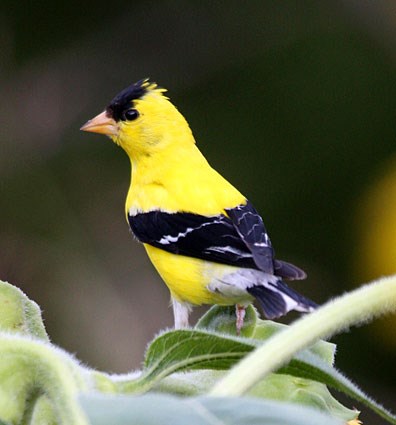
An adult male goldfinch in the process of becoming more brightly plumed (image: allaboutbirds.org)

Simply Living
January 30, 2012

There's an upside to having a neglected landscape. A weedy garden or overgrown field is a boon to some wintertime visitors.

The American goldfinch (Carduelis tristis) is a seasonal fixture in the Sunshine State. This half-ounce bundle of bones and feathers likes nothing more than discovering safe foraging grounds dotted with dandelions, ragweed, milkweed, evening primrose or — most especially — those prickly, pesky thistle plants.

Like any true lover of warm weather, the state bird of Iowa, New Jersey and Washington leaves Northern abodes in early autumn when cold winds carrying a hint of snow start ruffling feathers. Traveling south in large colonies that often include other migratory birds, goldfinches settle in areas where a temperate climate extends the growing season.

Lately when taking a walk, I've noticed flocks of "wild canaries," as they are nicknamed, flittering across our fields and open spaces. These 4-1/2-inch-long fliers with an 8-inch wingspan consider food finding a group effort. When not after the above-mentioned seeds, they munch on sunflower, cosmos, aster and grass seeds, occasionally snacking on tree sap, buds and berries with an incidental insect for protein.

Because goldfinches come to Florida for respite rather than procreation, we miss seeing their finest displays of color. During a Northern spring, the male boasts a golden body with a bright white rump. His wings are black with white stripes and a jaunty black cap covers his head. This jazzy get-up is all about attracting the gals — actually, one girl in particular. Goldfinches are monogamous and mate for life. After mating, the female proceeds to build a tightly woven, cup-shaped nest in the forked branches of a tree and lays four to six light blue eggs.

Adult male goldfinch fully feathered with colorful plumage and ready to mate. (image: allaboutbirds.org)

The reproduction period takes place mid-to-late summer when weed seeds are plentiful. The eggs incubate for 10 to 12 days before hatching and 12 to 17 days later, the young birds leave the nest to spend several weeks stuffing themselves with seeds. Shortly afterward, the hatchlings join up with other goldfinches migrating south to warmer weather.

By the time the birds arrive in Florida in early autumn, the male's yellow plumage has faded to a dull olive. However, as the months go by and anticipation of returning north to mate mounts, the males' cheery coloration begins to return. When mid-February rolls around, a lemony sheen appears on the male bird's underside, growing more brilliant as the weeks go by.

The female, with more need for protection than ostentatious presentation, doesn't go through a similar molt. She has no black cap and only a hint of yellow on her underside. Her slightly striped olive tones enable her to blend well with foliage year round.

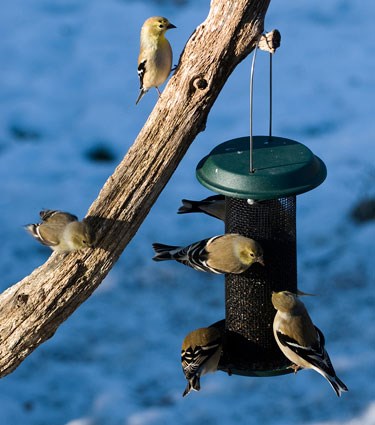
Goldfinches gravitate toward natural sources of food but when weed seed supplies dwindle, they frequent backyard feeders. People wishing to attract goldfinches can do so during winter by putting out fresh nyjer (thistle) and sunflower seeds. Nyjer is a high-energy food rich in oil. While nyjer seed will draw these pretty little birds to the feeder, its high oil content goes rancid quickly. To ensure a fresh supply, clean feeders at least once a month and store surplus seed in an airtight container.

Goldfinch gather around a thistle (nyjer) feeder (image: allaboutbirds.org)

Although I haven't filled feeders with nyjer or sunflower seeds, the goldfinches in our yard are not going hungry. Untended fields and weedy gardens provide plenty of natural foraging fare. To an uninformed eye, my garden might look ugly but the birds and I know there is beauty in sustenance. It's also reassuring to discover a beneficial side to laziness.

Sunday, January 22, 2012

In snake v frog there's only one winner

Hungry snake...doomed frog

Simply Living
January 23, 2012

People have it easy. If we're hungry, we go to the store, select food, go home and prepare a meal. If we're pressed for time, feeling lazy or indulgent, we eat at a restaurant.

That's not how it works for wild animals.

My husband called me away from the dinner I was preparing on a recent evening to come out to the porch.

"You've got to hear this sound," he said. "Some animal is screaming but I can't figure out what kind of animal or where it is."

We sat on the porch for about 15 minutes but didn't hear a thing.

"I guess it stopped," I said standing up, anxious to go back inside to check the vegetables roasting in the oven.

Just as I was about to leave, Ralph opened the porch door for one last look. That's when we heard it. Outside the door, a tiny young black racer snake had its mouth clenched around a green treefrog that was about 4 inches long. The snake, thinner than a pencil and less than a foot long, had a firm grasp on the frog's rear end. Despite the fact that all four of the frog's feet were free, its stance on life was fragile. Aware of the mortal danger it was in, the frog let out a mournful cry.

I had never before heard a frog screech. I didn't even know they could. Apparently, the situation triggered a primordial instinct. The clutch of a reptilian mouth caused the frog to emit a high-pitched scream. Black runner snakes overpower their victims by pressing their prey against the ground while holding them tightly within their jaws. It was a terrifying, life-threatening predicament for the frog.

For the snake, it meant dinner. No store-bought snack for this reptile. No drive-through dining or oven-roasted meal. Black racers eat rodents, lizards, frogs, birds and other snakes. They eat what they catch or they don't eat at all. For a snake — for any wild animal — dinner is not about preparation, presentation, mood or hour. It's all about survival, a do-or-die effort. It's not a pretty picture.

The snake, intent and patient, bit down on the frog, absorbing the amphibian's vital fluids.

Throughout it all, the frog was aware. Its eyes bulged, its legs twitched in frantic but fruitless attempts to flee. But the snake's hold was steadfast. I watched with horrified fascination, my camera tracking the frog's increasingly futile efforts to disengage and escape.

Tiny snake....big meal

In less than an hour, the snake had devoured the entire frog.

"Unbelievable," Ralph said as we watched the snake's muscles push the swallowed treefrog — now reduced to a large lump — down the narrow channel of its body.

"I never would have thought such a large frog could fit inside such a small snake," I responded as I pondered the frog's demise.

The snake remained on the concrete walkway silently digesting its meal. I returned to the kitchen, my own culinary efforts to check.

Digesting dinner

The snake and I had both spent about the same amount of time readying a meal that would provide us with sustenance. I cut up vegetables. The snake captured prey.

"People sure have it easy," I said to myself as I opened the oven door, the vegetables roasted to perfection.

I called to Ralph, "Dinner's ready!"

Monday, January 16, 2012

On my weekend agenda...go to the farmers market!

People shop and stroll along Montrose Street at the Clermont farmers market.

Simply Living
January 16, 2012

A Sunday morning spent perusing the farmers market in downtown Clermont can be a thrifty as well as fun experience.

My purchases on a recent excursion included three sweet red peppers ($1 each), two yellow squash ($1 a pound), a large head of broccoli ($2 a bunch), three butternut squash ($1 a pound), seven bananas (50 cents per pound), an 8-ounce package of baby portabella mushrooms ($2) and one eggplant ($1). For less than $15, I returned home with enough produce to satisfy most of our needs for the week at about half of what I would have spent for comparable purchases at the supermarket.

A colorful selection of vegetables fill my basket after a visit to the farmers market in Clermont
 
I'm a fan of farmers markets. Part of my weekly routine includes going to either the Saturday morning market in Winter Garden, where I meet up with my daughter, son-in-law and grandchildren, or the Sunday market in Clermont, closer to home and therefore more convenient. Every now and then, I go to both.

Although purchasing produce is my main objective, people go to farmers markets for a variety of reasons.

Farmers markets are a great place to find unusual gift items, locate a source of farm-raised beef or purchase plants for the landscape. Some use the markets to seek out handmade crafts, custom artwork or locally produced food. Food-truck purveyors are on hand to provide an assortment of snacks while vendors set up booths to sell everything from organic peanut butter to handcrafted jewelry to gourmet dog biscuits. You can get knives sharpened in Clermont, take home a loaf of freshly baked bread or a bag of loose-leaf tea. One Winter Garden purveyor offers samples of unusual cheeses while another encourages browsers to taste the flavorful crackers his wife makes out of dried tomatoes, herbs and flax seeds.

Free entertainment is another reason people frequent farmers markets.

Usually, a musician — often a guitarist — provides passersby with a medley of melodious tunes. In Winter Garden, visitors can rest their feet in one of the many chairs lined up in front of the performance area, which happens to be located next to a female vendor who stays busy demonstrating a type of hula-hoop exercise equipment she sells. Customers can munch on homemade pastry and sip a cup of java while they listen to music, check out the hula-hoopers and watch the crowd go by.

A guitarist entertains passersby while canine visitors exchange nose-to-nose greetings at a downtown market
 
People watching is a popular occupation. With such a diverse group frequenting the markets, watching the crowd stroll by is a pleasant diversion from the workaday world.

Most farmers markets are located in downtown areas. A main street is often closed to cars for several blocks allowing pedestrians to walk without worry about vehicle interactions. This makes the venue popular with families, especially those with toddlers and babies in infant carriers or strollers. That also makes it well attended by bicyclists and pet owners.

Sometimes I think there are more dog owners proudly parading along behind their pets at the local outdoor market than any other category of shoppers. Something about a farmers market attracts a canine-loving crowd. Perhaps it's the opportunity to show off their well-behaved pets or simply to enjoy an outing amidst an admiring audience of children and adults. Kids certainly seem to appreciate the dogs' presence, often stopping mid-street to stoop down to pat the friendly animals.

The open-air ambiance of a farmers market is as appealing as its randomness. I never know from week to week who will show up. Although there are definite regulars, the inexpensive rent makes it affordable for small businesses to test the market without having to make a long-term commitment.

In addition to the farmers market itself, local shop owners in both Clermont and Winter Garden often extend store hours to take advantage of the crowd. This is particularly relevant at the Sunday market in Clermont, a day when most stores are normally closed.

One business that opted to be open on Sunday is the South Lake Animal League Thrift Shop. After browsing the booths set up along Montrose Street and stowing my produce purchases in the car, I make a point of popping into the thrift store to look for bargains. Meeting up with my daughter, son-in-law and grandchildren is the draw that gets me to Winter Garden, but having a chance to peruse the racks of gently used clothing, most available for the bargain price of a dollar per item, attracts me to Clermont.

There are many reasons to explore farmers markets. Whether doing it to save money, buy local or simply as a way to enjoy some free outdoor entertainment, check out the offerings near you. In addition to Clermont's Sunday market and Winter Garden's Saturday venue, the farmers market in Tavares is on Friday and in Leesburg on Saturday. All are located in the downtown areas and open from morning to early afternoon.

For a complete listing of farmers markets throughout the state visit farmersmarketonline.com/fm/Florida.htm.

Monday, January 9, 2012

Celebrating a year of walking while working

A 1x10 board laid across the arms of the treadmill provides support for a laptop.


Simply Living
January 9, 2012

A year ago this week, I replaced the desk and chair in my office with a treadmill. For the past 365 days, whenever I've wanted to check email, write a column, do online research or see what's new on Facebook, I've done so in an upright position. My fingers tap the keyboard while my feet pad along on a band of movable floor.

My husband, a disciplined exerciser whose daily three-mile loop around the lake has been an integral part of his routine for years, has watched my indoor rambles with mystified indulgence.

"I don't know how you do it," he says, referring to my ability to punch computer keys while maintaining a steady pace. But what he's really wondering is: Why? Why would I opt to walk inside when I could be outside enjoying the fresh air and scenery?

I do it because I like it. I do it because I can. I do it to burn calories. I do it for my health.

Computers have the uncanny ability to alter time. A few minutes checking email can easily turn into two hours of browsing the web.

If I hadn't replaced my desk and chair with a treadmill, my derriere and the cushioned seat would be wedged together for a good part of the day. Sure, I'd get up for breaks, and I might even go outside to join my husband for a walk around the lake, but I'd spend the majority of my daytime hours sitting down fixated on a LCD screen.

With such a proliferation of technological gadgets vying for our attention these days, it has become common to spend more time exercising our fingers than our feet. That doesn't make it right. Or healthy.

A number of studies support the position that sitting down is causing rising health problems.

"Prolonged time spent sitting, independent of physical activity, has been shown to have important metabolic consequences," said Dr. Alpa V. Patel, senior epidemiologist at the American Cancer Society and lead researcher of a 2010 study on how sitting affects mortality.

Patel's research, which spanned 14 years and included 123,000 subjects, showed that women who sit for more than six hours a day were about 40 percent more likely to die during the course of the study than those who sat fewer than three hours a day. Men were about 20 percent more likely to die.

I have no desire to die early, but neither do I want to sweat my way to good health. That's why working at a treadmill desk is ideal. It is nothing like a ruthless gym workout. When walking-while-working on my treadmill, I do so at the leisurely pace of 1 mph.

At such a slow speed, integrating thoughts with actions is seamless. I'm able to do everything I ordinarily would do on the computer, but I do it while burning more than 100 calories an hour. Multiply that by the four to five hours I normally spend in my office and the numbers become significant.

One mph is the speed recommended by Dr. James Levine, an obesity expert at the Mayo Clinic in Rochester, Minn., and the person responsible for popularizing the concept of a treadmill desk.

"It's amenable to regular people," said Levine in a 2010 interview with The Plain Dealer in Cleveland. "You don't need to have a gym membership. You don't need to be physically trim to use it. And you don't need to sacrifice productivity or access to the workplace in order to improve your health."

That certainly has been true for me. I love my treadmill workstation, a homemade desk made out of a length of wood laid across the treadmill arms upon which my laptop sits. I love knowing that every time I log on to the Internet I'm strengthening muscles, building bone and improving my overall health.

Sometimes getting on a road to self-improvement doesn't necessitate a road at all. An inexpensive, easy-to-construct treadmill workstation has the power to transform a sluggish, tired workaholic into an energetic, happy and much healthier walk-a-holic. That's one feat my two feet can really take a stand on.

Monday, January 2, 2012

Mother of thousands


An umbrella of red blooms sits atop a leggy stalk on a Mother-of-thousands plant

Simply Living
January 2, 2012

There’s a plant growing in my yard that I can’t seem to get rid of.  Some people call it Mexican hat plant, Devil’s backbone or Alligator plant.  Others know it as ‘Mother-of-thousands’ but from my experience, ‘Mother-of-millions’ might be a more appropriate moniker. 

The botanical name of this prolifically reproducing succulent is Kalanchoe daigremontianac.  Native to southwestern Madagascar, Mother-of-thousands is a perennial in Florida and other warm-weather regions of the country.  In colder climates, it is cultivated as a houseplant and perhaps that’s where it belongs – some place where carpet, tile and hardwood flooring will limit its uncanny ability to self-propagate prodigiously. 

Mother-of-thousands looks a bit like aloe.  This potentially 3-foot-tall plant has a center stalk out of which grow a series of fleshy, 4 to 6-inch long serrated leaf-like stems that are green with a hint of purple on the undersides.  During winter months, the stalk can produce an umbrella shaped terminal from which dozens of bell-like red flowers dangle.   

Hummingbirds favor this attractive bit of botanical finery, which should make this easy-to-care-for perennial a welcome addition to the wildlife garden.  Unfortunately, its invasive nature counterbalances its more positive features.

The key to Mother-of-thousands’s reproductive magic is visible on the edge of each of its leaf-like stems where small, round dark-colored plantlets form.  One ‘leaf’ can contain 20 to 50 of these babies-in-waiting and every Mother-of-thousands plant boasts at least a dozen leaf-like stems.  Do the math and the potential problem becomes obvious.

When the plantlets fall off, sometimes with white thread-like roots already in place, they settle on the ground and proceed to grow.  Not fussy about soil needs, Mother-of-thousands seedlings have successfully rooted on our property in moist spots as well as in areas where water supply is limited.  Much to my vexation, these tenacious succulents even manage to flourish where soil is seemingly nonexistent.  I’ve seen plantlets achieve purchase in the cracks of concrete walkways as well as in the narrow spaces between our paved patio and stucco walls.   

Who needs dirt?  Mother-of-thousands can sprout and grow in the tiniest crack in concrete

On the positive side, Mother-of-thousands is easy to uproot.  One yank with a gloved hand (to protect against the serrated edges) can pull these shallow-rooted perennials from their roost.  On the negative side, each yank has the potential to dislodge several of the small, round dark-colored plantlets, making the entire let’s-just-yank-them-out-to-get-rid-of-these-pests plan redundant.

Considering the difficulty of total eradication, I’ve opted for the same approach with Mother-of-thousands as I’ve taken for Mexican petunia (Ruellia brittoniana) and wedelia (Wedelia trilobata), two other overly active reproducers that I made the mistake of introducing to the property.  I stop treating them like garden plants.  I dig up and relocate the offending perennials to wooded areas where they receive no irrigation or soil enrichment.  I’ve found that when I stop treating invasives like pampered garden plants, they stop acting like unruly, out-of-control pests.       

Mother-of-thousands isn’t a bad plant.  It just isn’t the right plant to put in certain places.

Learning as much as possible about a plant’s behavior before installing it in your yard goes a long way toward avoiding future problems but don’t fool yourself into thinking education will put an end to errors.  A cultivar’s beauty, color, fragrance or special characteristics can sway the mindset of even the best-intentioned gardener. 

To prevent plants like Mother-of-thousands from becoming Mother-of-millions, exercise a gardener’s form of tough love: “You can stay on the property but I won’t spoil you.”

When miscalculations occur, make the best of them.  Sometimes an effective compromise is the right answer when total eradication is too daunting. 

Saturday, December 31, 2011

Your choice...

I wrote this poem in 2002 but it continues to represent my feelings for the New Year... 


An optimist and pessimist await the New Year Hour
One with eager smile, one's expression sour.

The pessimist looks back and groans, "Time goes by so fast!"
The optimist looks back and grins, "More memories to last!"

The pessimist recalls the debts, the dollars thrown away.
The optimist recalls the gains, the values earned each day.

The pessimist sees struggles fought, times that trouble crossed.
The optimist sees each success and respects the cost.

The pessimist looks back and sighs, "I should have not done that."
The optimist: "How much I've learned..."  And gives himself a pat.

The pessimist says, "What a year!  I've never known such woe."
The optimist says, "What a year! ...Amazing how we grow."

One with eyes so used to seeing problems every day.
One with eyes so used to seeking out a better way.

An optimist and pessimist await the New Year Hour
One with eager smile, one's expression sour.

And when the midnight chime does ring both turn to look ahead
The optimist with hope and dreams, the pessimist with dread.

So pour a toast and raise a glass.  Take a drink until
Your glass reflects the year ahead:  Half empty or half full.

Monday, December 26, 2011

A new year = a new chance for successful sandhill crane nests

Roosting cranes prepare to spend the night on a tiny spit of land submerged beneath a thin sheet of water.

Simply Living

December 26, 2011
 
We haven't had a significant rain in weeks and because of that, the level of water in our lake has gradually decreased. Islands of peat and sand that are normally submerged have begun to appear.

I'm not the only one to notice. A pair of sandhill cranes has returned, flying in every evening to roost on one of the tiny spits of land surrounded by shallow water.

For years, the seasonal islands in our lake have been the preferred nesting spot for a pair of sandhill cranes. Like many birds, sandhill cranes return to the same nesting places annually. In our lake, their chosen spot is always an island, a minuscule land mass a short distance offshore.

It's a precarious choice.

If the weather cooperates and rainfall is limited, the lake level will continue to drop and the islands will stay visible and viable for nest building. However, if sudden downpours happen and precipitation increases, the water level will gradually rise. The islands (including any nests and eggs) will disappear beneath a blanket of waves.

The sandhill cranes don't seem to mind the insecurity of their nesting site. Instinct tells them to return to the spot where they've nested before so that's what they do. Even though previous nests have been lost when water levels rose, an inner voice commands and they dutifully follow.

Earlier this year I watched as the birds — most likely the same two frequenting the lake today — industriously built a tidy nest of sticks and reeds on spit of land a few feet off the northern shoreline. First one then two eggs appeared. The adult birds diligently guarded their nest but no amount of care or avian protection could prevent rain from falling. In April 2011, water levels rose steadily until one day the nest vanished, submerging the eggs in a watery grave.

Two sandhill crane eggs as seen a few days before they disappeared beneath rising water in our lake last April.

It surprises me that the birds don't remember. If they did, I would think they'd try harder to find a different spot to raise their young. As Ralph and I walked around the lake, we passed several large masses of peat and sand that had recently appeared. The two cranes, however, hadn't chosen one of those islands for their nightly roost. The only visible parts of the still-submerged isle they selected were a few reeds poking above the quiet water.

Change happens quickly.

If it doesn't rain for a few more days, more land will appear. If we have a dry winter and if the birds decide to stay and build a nest, the eggs they lay will have a good chance of surviving.

That's a lot of ifs.

Nature is nothing if not full of surprises. I find it surprising that the sandhill cranes have returned to the same place they have nested before and equally surprising that they've timed their arrival exactly when the water level is low enough for submerged islands to appear. But perhaps most surprising of all is the resurgence of hope their arrival triggers.

Despite past disappointments, I'm optimistic that this time around nest building will be successful for the sandhill cranes. I'm hopeful that any eggs they lay will live, and any chicks that are born will survive.

We're on the cusp of a new year. I can't think of a more appropriate time for a flush of irrational optimism.

The sandhill cranes act on instinct, but they're not the only ones listening to an inner voice.

My instinct tells me to be ever hopeful, to see things in a positive light and wish for the best. Like the birds attempting to nest in our lake, I'm not always successful but that doesn't stop me from hatching hopes anew.