Monday, December 12, 2011

Vines are...divine!

Blue sky vine beautifies a chain link fence
Simply Living
December 12, 2011

I love vines.

I love their tenacity and reckless abandon. I love the way they march onward and upward despite minimal care and attention.

I find their variations in fragrance, color and delicate beauty appealing. I see vines growing in wild places or in other people's yards, and I want them. They captivate and entice me.

Fortunately, I'm learning to resist.

Vines have a way of taking over. It's in their nature. If you are prepared and willing to put the time and effort into reining them in, then cultivating vines is a worthy occupation. They can look lovely crawling over an arbor, trellis or pergola, and they work well at hiding an unattractive wall or object. Vines add beauty to a hanging basket and do a good job as a ground cover. However, if you are unable to regularly monitor and control their growth, a pretty little vine can turn into a pretty big problem.

I've made the mistake of planting vines and watching them grow out of control on numerous occasions. I've done it with wild morning glory, purple and white wisteria, passionflower, cypress vine and Dutchman's pipevine. In each case, what started as a snip — a tiny cutting gleaned from a larger plant — turned into a rambling monster over the course of a summer.

Part of the problem is that vines know no bounds. When you plant a broccoli seedling or an impatiens plant, it grows bigger and broader but never wanders. It stays put — a concept that doesn't mesh with the word "vine."

A vine's essence is to grow up, stretch out, sprawl sideways. It does whatever it can to extend its range as far away from the initial root as possible. Some vines do their climbing with help from tendrils, while others twine or use aerial rootlets. Whatever the method, the result is expansive growth far beyond where the plant was originally established.

Pruning is necessary to keep vines in check.

When it comes to vines, I also require a certain amount of restraint. I need to prune back my predilection to cultivate more vines than I have time or energy to control.

Recently, I've found myself coveting a blue sky vine that grows along the entry fence to a home on one of the back roads I frequent. Every time I drive by, I feel a yearning. I want that vine! Its flowers are such a beautiful shade of blue. It looks so pretty along the fence.

If I stopped and asked, I'm sure the homeowners wouldn't object to my taking a clipping, snipping off a little segment to plant at my own home. But if I got a clipping, what then? Once it was rooted, where would I place it? Would it grow out of control as so many other vines have done? Would it become a problem?

It probably would.

Before I add any new vines to the landscape, I need a plan, a place for them to grow and a means to control them when — not if — they start to grow out of bounds.

I have a solution, at least in my mind.

I envision a series of arbors in a long row. The arbors would form a tunnel that I could walk through and on each one, a different vine would climb and twine. The arbors would be separate so that the plants couldn't intermingle. Mowing the ground between them would keep them contained.

I love vines but I'm trying hard to resist the urge to add more to the landscape. Someday I might get a snip of that lovely blue sky vine but I've promised myself it won't be until all the necessary infrastructure is in place and I have the time and inclination to keep the vine in check.

Monday, December 5, 2011

Firespike adds festive touch to garden

A cloudless sulfur butterfly sips nectar from a firespike bloom

Simply Living
December 5, 2011

During December when brown leathery sycamore leaves are covering the ground and orange tangerines dangle from citrus trees like ornaments, the waxy red blooms of firespike add a festive glow to the garden.

Firespike, botanically known as Odontonema strictum, is an herbaceous perennial with foot-long spikes of showy flowers extending out of glossy foliage. Standing about 6 feet tall in shrubby clumps, this South American native is a wonderful addition to the landscape because it doubles both as an easy-to-grow bush and a wildlife magnet to butterflies and hummingbirds.

I can't remember when I first discovered the firespike plant or where my original cutting came from but this late-summer-through-winter bloomer has been adding color to my garden palette for years. Because it is so tall, firespike does best as a background plant where it can stretch upward without overshadowing shorter plants.

On several occasions, I've made the mistake of placing it in the wrong spot but I've managed to dig up and move plants without problems. That's because firespike is resilient. This drought-tolerant perennial will happily grow in sunny as well as shady locations and is easily propagated by divisions, cuttings or sometimes even by sticking a clipped off branch into the ground.

One has to wonder if a plant this easy to propagate is invasive. Fortunately, the answer is 'No.' Although it readily reseeds, sprouts don't emerge far from the mother plant so it doesn't spread out of control. New shoots merely increase the bush's girth.

Firespike's waxy red blooms, born in clusters along foot-long stems, make great cut flowers. They look especially nice in bouquets with Mexican sunflowers, another late-season blossom. I'm not alone in finding firespike attractive. Many species of butterflies like them as well. Cloudless sulfur butterflies are especially fond of this winter source of nectar. On a sunny day, several of the white-to-pale-yellow flutterers hover around a bush as if awaiting entry to a popular eatery.

Hummingbirds come to dine, too. Individual flowers have thin tubes with fluted rims that seem ready made to accommodate a hummingbird's bill. The blooms are also a brilliant candy-cane red, a color hummers find most attractive.

If you're thinking firespike sounds like the perfect plant, you're not far off. In addition to its tolerance of either shade or sunlight, firespike accepts a variety of soil conditions. It does well in sandy, loamy or even clay soil and doesn't suffer when pruned back during the growing season.

However, like most things that seem too good to be true, firespike has an imperfection: It can't tolerate cold. For the past three winters, freezing temperatures have killed back the top growth on every one of my bushes. Although the roots don't die and the plants rebound the next year, their sensitivity to cold leaves me, well, in the cold.

A single failing, however, can't spoil my enjoyment of this seasonal beauty. If firespike makes December a bit more festive and then fades away when freezing weather hits, so be it. Sometimes it's the tiny flaws that make us appreciate beauty, and the inevitable fade only makes the present more special.

Monday, November 28, 2011

Savor the moment

Watching the babies you once held in your own arms mirror that love to a new generation is one of life’s many pleasures. In picture:  (bottom row, from left) Brett Constantine holding Ella Constantine, Jenny Boas holding Maya Constantine (top row, from left) Amber Boas, Atom Fischler, Scott Fischler  

Simply Living
November 28, 2011

At the end of October, I celebrated my 60th birthday. I've made many discoveries in my lifetime, but perhaps the most relevant is that the older I get, the more precious time becomes. When I was younger, I often wished time away.

"I can't wait until summer," I'd say, or "I wish it were the weekend."

These days, I try not to do that. I've come to realize how precious and limited time is, so I try to savor the moment. Not only do I take time, I consciously make time to treasure everyday pleasures.

It's the little things that make my heart sing. When I wake up and see the morning mist on the lake, I smile. I consider the amber light that precedes dusk a gift. When I smell a flower, pick a bouquet or watch the erratic flight of a dragonfly, I'm enjoying nature, souvenirs of life that are always there if I only make an effort to look at them and see.

Not a day goes by without multiple reasons to be thankful. The very act of waking up is a gift in itself. When I'm feeling bad — if I'm sick or upset, weary or depressed — I try to consider how much worse things could be. I'm thankful for the good times. I'm grateful for a world filled with marvel and wonder, for the love and caring of family and friends.

My husband, children and grandchildren provide endless sources of bliss. Ralph's kindnesses and little gestures — the breakfast he prepares for us each morning, the way he runs his fingers through my hair when we're watching TV, his eagerness to spend time with me, his patience and consideration — make me feel loved and appreciated.

Some people think money and material items are important, but my fortune is in having such a caring partner. My husband and I share that richness by passing it along to future generations.

This past week centered on family. All four of our offspring were here, including my two daughters, who have children of their own. As I watched Amber with her 2-year-old son and Jenny with her 3-month-old twins, I was awed not only by the passage of time but also by the layers of love that exist in a family. Seeing your own children grow up is remarkable in itself, but even more amazing is watching the babies you once held in your own arms mirror that love to a new generation.

Sixty years is the equivalent of 21,900 days, and while 21,900 is a large number, I don't think it could ever be big enough to waste even one of those days on wishes of tomorrow. The present is a gift that's precious and special. Being present — being aware of what's happening in the moment — is perhaps the most valuable gift of all.

Monday, November 21, 2011

Knock-knock...who's there?

An Eastern Phoebe poses on a bamboo cane before attacking its reflection in the window

Simply Living
November 21, 2011

Several years ago, a rufous-sided towhee raged war against the window in my old office. Every day for weeks, the male bird relentlessly attacked the glass with his black, pointy beak.

A couple of years later, a red cardinal engaged in a similar battle. However, unlike the towhee, which focused his testosterone-triggered attention on one particular window, the cardinal made a broader territorial claim. His war involved any surface reflecting his image, including the side-view mirrors on my car.

This year, a new bird has taken up the cause. An Eastern phoebe, a sweet little bird in the flycatcher family, is determined to prove his prowess against the reflection he sees in my current office window.

The Eastern phoebe is a medium-size, brownish-gray bird with white-buff undersides, a black bill, a forked tail and a slightly oversized, darker gray head. One of the phoebe's distinguishing characteristics is the bobbing of its tail feathers up and down, often accompanied by the fluffing of its crown feathers.

Phoebes are wonderful birds to have around homes and gardens because they eat the insects most people find annoying. Ticks, spiders, flies, gnats, mosquitoes, moths, bees and wasps are among the delicacies phoebes enjoy. Bugs are usually caught on the wing, but the phoebe will occasionally pluck an insect off plants or, as I've recently observed, off a window screen.

Distinguishing between the two sexes by physical characteristics alone is difficult with phoebes. Males are slightly larger, and their plumage is somewhat darker, but both of those traits are hard to observe unless the birds are together — and phoebes rarely are. I saw two birds on one occasion, but the rest of the time, I've seen only one. From my observations of that solitary bug-catcher, I've concluded that the bird attacking my window is male — not by the way he looks but by his actions and voice.

Although female phoebes sing, their songs are brief and infrequent. The bird I've observed vocalizes continually. His habit is to perch upon a bamboo pole about three feet away from the window, bob his tail, make some noise, flutter a few inches up into the air, turn around and resettle on the pole, only to repeat the pattern. Intermittently, he attacks the window with his beak, sometimes latching on to the screen with his little claws, spreading his tail feathers and wildly flapping his wings.

The first time that happened, I got scared. I thought the bird was stuck, so I ran outside to help. I needn't have worried. Apparently, the whole body-to-the-window thing was part of his hormonally driven plan to thwart adversaries. As soon as the bird saw me, he easily detached himself from the screen and flew away. I guess the phoebe thought if he waged an all-out, full-body approach, he might succeed at scaring off his reflection. No such luck.

Male birds attack their reflections because of what scientists call "gonadal recrudescence." Testosterone surges during spring mating season and again in autumn. This hormonal flush causes some males to enter defense mode. They deal with any perceived threat to themselves or their mate through posturing, vocalizations and direct body contact.

Such noble but fruitless efforts … such winged flights of fancy.

As much as I love birds, I find the actions of these males baffling. Head-banging against glass seems a step backward on the evolutionary highway.

It's not as if birds are incapable of learning new behaviors. Over time, birds have learned to avoid poisonous or foul-tasting insects. They've learned not to frequent areas that would put them into direct contact with predators. There is even evidence that some birds have learned to avoid newly established and potentially harmful wind turbines. Yet, these flying bits of feather and bone can't overcome the urge to attack their reflection.

The little phoebe at my window is the latest in what will most likely be a stream of avian gladiators, willing to risk their all in defense of their families. Birds may be small — the phoebe weighs less than three quarters — but they are large in determination and devotion to a cause. I just wish their efforts were less painful.

Monday, November 14, 2011

Snakes make me feel safe

A black racer slithers across the lawn

Simply Living
November 14, 2011


I was about to enter the porch from outside when a long, black snake slithered by.

"The black racer's back!" I shouted to Ralph as I stepped back to let it pass. "It's heading toward that hole underneath the addition."

Ralph and I share our yard with a number of non-venomous snakes, and the black racer is one of our regulars. We have what I like to think of as a symbiotic relationship. In exchange for a yard filled with snake-friendly hiding places, these slithering cords of bone and scale keep the rodent population in check. It's a mutually beneficial arrangement.

Although many people would shudder at the thought of coexisting with snakes, I find it comforting. Snakes make me feel safe because, although I seldom see them, I know they are out there patrolling the ground around my house. I don't love mice, but snakes do. They love them to death — a good thing because the fewer mice there are to sneak into my house, the happier I am.

My affection for snakes is not new. I've felt this way since childhood, which is somewhat surprising since I grew up with a parent who abhorred snakes. My mother was so frightened by long, squirmy creatures that even an earthworm could trigger a trembling frenzy. Looking back, I can see how my mother's irrational fears might have prompted my own positive attitude. I like snakes in part because I know how misunderstood and underappreciated they can be.

Of the 50 snake species in Florida, only half a dozen are venomous, and two of the six (Southern copperhead and timber rattlesnake) are not even found in the central part of the state. Every year, venomous snakes bite about 8,000 people in the United States, but an average of only six people die from those bites. Nine times as many fatalities occur annually because of wasp, hornet or bee bites. The number of snake-related deaths is far too small to warrant such widespread paranoia.

Unfortunately, it doesn't matter how few dangerous snakes there are or how rarely snakebites result in death. Snakes remain one of the most maligned animals on the planet. All members of this beneficial species receive universal hatred and fear.

It's odd that creatures that do so much good are the subject of such loathing. Without snakes, mice and rat populations would get out of control, causing disease-carrying rodents to run rampant in yards, barnyards and houses. Fortunately, snakes don't let that happen. Unbeknownst to most humans, snakes go about their business of silently stalking and devouring prey. No dangerous poisons are necessary when snakes are on the job. No-pest control companies are involved or dollars exchanged. Snakes work for food and, luckily for us, the foods they prefer are the animals and insects we least want around our houses.

When I chanced upon a black racer as I was about to enter the porch, my reaction wasn't fright but delight. I hadn't seen the snake in a while, but the black racer was there all along. It was just doing what snakes do — furtively stalking sources of food and absorbing heat from the sun.

In a perfect world, people wouldn't react with irrational fear to animals that do more good than harm. They wouldn't go crazy at the sight of snakes. The vast majority of snakes in Florida present no threat to humans, yet people kill them indiscriminately. My yard is far from ideal, but when it comes to snakes, it is a perfect haven.

"I'm going to run inside to get the camera," I called to Ralph after I saw the snake. But by the time I returned, the black racer had disappeared into the hole. Fortunately for me (and for the snake!), there will be a next time.

Monday, November 7, 2011

An anhinga discovers Bare Lake

An anhinga spreads its wings wide to dry in the breeze

Simply Living
November 7, 2011

An anhinga has taken a liking to our lake. It arrives in the morning and spends the day either in the water fishing or perched nearby drying its wings.

Anhingas differ from most water birds in that they don't have oil glands to waterproof their feathers. Unlike ducks that can dive under water and return to the surface, the anhinga must air-dry its feathers after each submersion. The bird in our lake re-fluffs its feathers in various locations. Sometimes it sits atop the mid-lake platform, while other times it stands on a partly submerged log, on the uppermost canes of bamboo or even on the arms of a plastic chair on our beach.

"Come see this bird by the beach!" my husband called from the porch.

"It's an anhinga," I said when I joined him outside. "Or a cormorant — I'm not sure which."

Because the two birds look very much alike and have overlapping habitats, they are often mistaken for each other. Both are large, dark-colored water birds without oil glands that swim through the water with only their heads exposed and spend extended periods perched along waterways air-drying their broad, outstretched wings.

Although there are several noticeable differences between the two fish-eating predators, the easiest way to determine which bird is which is to focus on the neck and bill. If you are looking at a slender, long-necked bird with a straight, pointy beak, it's probably an anhinga. However, if the bird you see has a shorter neck with a curved, hooklike bill, it is most likely a cormorant. Cormorants also have a distinctive orange throat pouch as well as a stockier body and shorter tail feathers than anhingas.

Despite those differences, I still get confused. I've found the easiest way to distinguish between the two is to think of the anhinga's nickname, snakebird. Since the anhinga's neck is so long, it is sometimes mistaken for a snake.

Anhingas and cormorants share similar diets, but their methods of catching food differ. The cormorant uses its hook-shaped, serrated-edge beak to grasp slippery prey, while the anhinga impales its catch on its long, pointy bill. Once prey is caught, the cormorant will eat under water while the anhinga tends to devour its meal on land by tossing it into the air and swallowing it whole. Occasionally a fish will be so severely speared that the anhinga will have to ease it off its beak by rubbing against a hard object.

I haven't watched the anhinga in our lake devour any fish, but I have seen it dive off its perch in search of food. The main time I notice this 3-foot-tall water bird is when its 48-inch long wings are open to catch the breeze.

"It really seems to like that plastic chair," my husband said as we stood outside watching the bird watch us while it air-dried its wings.

"I thought it would mind us being so close but it doesn't seem scared," I said as we eased closer to get a better look.

The bird didn't have much choice but to wait patiently for us to go away. An anhinga with wet wings has difficulty flying. It can do little more than skip along the water's surface while madly flapping its wings.

"I'm glad it's here," I said, when we returned to the house. "I like looking out and seeing it on the perch. It's a weird- looking bird, especially with its wings outstretched, but also exotic."

Herons, ibises, wood storks, egrets, rails, grebes, ospreys, hawks, various ducks and the occasional eagle have all made their appearance on our lake at one time or another. Some are regulars while others come and go with the seasons. Whether the anhinga is an occasional visitor or takes up residency matters little. Every bird is a welcome addition.

CORRECTION
I recently received an email from an Everglades National Park volunteer with some relevant information about anhingas.  Here's his email in full:

I recently read one of your 2011 articles on Anhingas, and felt an
irresistible urge to correct an error of fact. Anhingas do have
uropygial or preening oil glands. Their wing and tail feathers are
fully waterproofed contrary to Audubon and most other sources, even
reputable ones. Please see photos (1st one not mine) showing gland and
preening. Another way to prove this is to take a feather, dip it it
water, remove, perform a couple of Flitwickian swishes and slicks, and
you will be hard put to to wring even a small droplet of water.

I have had to suffer an education about blindly accepting "facts" from
authoritative sources on nature. As an Everglades National Park
volunteer whose job includes interpreting wildlife for visitors, I now
check everything with judicious observation and with experienced
colleagues. I preface what I say with "I have read that..." or "we
think that...." Only when I have verified something by observation and
concentrated research can I claim something is true. And even then, I
suspect that half of what I say is wrong.

Meant in a friendly way....

Chris Reiss

Monday, October 31, 2011

Halloween makes me happy

Creative homemade decorations are displayed at a house in Minneola
Simply Living
October 31, 2011

I often found myself smiling as I drove through town these past few weeks. The reason for these sudden bursts of levity was tonight's holiday, Halloween.

Instead of just treating it as a one-night celebration, as it was when I was a child, an increasing number of people now extend the fun by decorating their front yards weeks in advance with spooky or simply playful displays. From the yards I've passed, I'd say the most popular decorations are giant spiders, spider webs, fake gravestones and dangling displays of ghosts, goblins and witches. Most of these Halloween symbols are store-bought, but I've come upon quite a few homemade exhibits as well.

People who choose to decorate yards usually opt for a few well-placed pieces to depict the mood they want to convey, but not everyone subscribes to the "less is more" concept. Just as some homeowners go over the top at Christmastime, certain people seem to know no limit when it comes to Halloween.

The resident of a two-story wooden house in the west Orange County town of Oakland is a perfect example. Dozens of life-size, scary-looking creatures fill this house's expansive front and side yards, while ghouls of every sort hang from trees and leer at passersby from the house's second-story balcony.

A home in Oakland goes a bit over the top with Halloween decorations

The yard is so cluttered with every conceivable holiday symbol (think jack-o'-lanterns, skulls and crossbones, spiders, gravestones, scythes) that it would be a challenge to count them all.

"Where do you suppose he stores them all when Halloween is over?" my practical husband wondered as we drove by the house. Not my first thought, but I had wondered that, too, especially since I know the same homeowner decorates his yard just as elaborately for Easter, Christmas and Thanksgiving.

The Oakland house is a marvel of holiday mania and attracts plenty of attention, but going all out isn't necessary to make an impression. One of my favorites is a simple Halloween display in a quiet Minneola subdivision.

Three pair of what look like adult-sized human legs protrude from the ground in this postage-stamp-size front yard. The fully dressed appendages are the only things visible. No head, arms or torsos are in sight.

When I first passed this display, my imagination was piqued. My eyes saw legs and feet, but my mind imagined upper bodies buried. Although the feet are immobile, I envisioned them kicking and thrashing about. I bet the person who created it gets a good chuckle whenever drivers like me do a double-take.

That's the thing about Halloween — it's such a playful holiday. Being different is applauded on Halloween, and outrageous behavior is acceptable. It's a holiday of broken rules. On most nights, kids are discouraged from eating sweets and told to keep their distance from strangers, but on Halloween, they're encouraged to knock on the doors of people they don't know and ask for goodies. Adults who might otherwise never talk to one another have a reason to be sociable, generous and friendly. On this one night of the year, neighborliness trumps discord, and fun and frolic win out over reserve.

Tonight on Halloween, I'll be accompanying my 27-month-old grandson and his parents on a short romp through their Winter Garden neighborhood. At his young age, I doubt if Atom can grasp the holiday's significance, but even at the tender age of 2, he's completely on board with the concept of "treats."

"More yummy!" I imagine him saying as he grabs yet another candy bar from a neighbor's hand.

For me, it will be a pleasure to see my grandson dressed up in a silly costume, continuing a practice that has been such a fun part of our family's traditions for years. Everyone can use more reasons to smile, and Halloween is a holiday ready-made for doing just that.

Sunday, October 23, 2011

Coyote by the side of the road

The coyote is a close relative to the domesticated dog but relies on its own wits and hunting skills to find food.


Simply Living
October 23, 2011

On my way to town, I saw a dead coyote. A wave of sadness washed over me as I drove by. I wondered if the animal was male or female. If it was a female, did she leave a litter of pups? If the animal I saw had pups, would they be old enough to survive on their own?

Coyotes give birth to an average of six babies, though depending on conditions, a litter can be as small as one or as large as 19. The pups are blind for their first two weeks and don't accompany their mother on hunts until they are 6 to 10 weeks old. After a year, coyotes become sexually mature, and they mate for life. If the coyote I saw had a partner, its mate was suddenly alone.

I realize that many people don't share my empathy for these wild members of the dog family. To them, large predatory animals such as coyotes pose a threat to the safety of humans and their pets, and that perceived danger justifies the animals' eradication. In their minds, the only good coyote (or alligator, bobcat or bear) is a dead one.

I feel differently. My heart goes out to all unfairly maligned critters — spiders and snakes included — struggling to survive in a human-dominated world.

Most wild creatures have it tough. People are constantly modifying animal habitat in the name of progress, often eliminating nesting grounds and natural food sources. Then, when the same animals whose homes and hunting grounds we've destroyed seek out alternative sources of food and shelter to survive, we victimize them for their efforts. We label them "dangerous" without bothering to understand who they are, what they are all about or how we may have contributed to the problem.

The coyote is a close relative of the domesticated dog. However, unlike pampered house pets whose human handlers present them with a daily diet, these 17- to 46-pound wild mammals must rely entirely on their own wits and hunting skills to find food for themselves and their offspring.

Mice, rats, squirrels and rabbits make up most of a coyote's diet, supplemented by fruits, insects, frogs and, at times, carrion. Occasionally coyotes — especially those with compromised hunting grounds — seek food in areas where farm animals or pets live. That's usually when problems arise.

Pet owners get scared if coyotes wander through a neighborhood, and ranchers feel threatened. That fear turns into rage if wild animals capture and eat livestock or attack a free-roaming house cat or small, unleashed dog. However, when a cat captures a songbird (often killing but not eating the bird), the typical pet-owner response is a resigned shrug, as if to say, "Ah, well, that's what cats do."

Pets receive a generous amount of leeway denied to wild animals such as coyotes.

I understand the sadness felt when a beloved pet dies unexpectedly. Years ago, an alligator ate our 13-year-old terrier, but the loss of the family pet to a hungry reptile didn't make me hate alligators. I knew that the 6-foot-long predator was only doing what alligators do: hunting for easy prey. We were aware at the time that an unusually aggressive gator was present in our lake, yet we thoughtlessly let our unleashed dog outside. It was our responsibility as pet owners to have better monitored his whereabouts.

In the wild, a coyote has a life span of 10 to 14 years, but just over 20 percent make it to adulthood. October or November is when most pups are mature enough to forage on their own, but those young, inexperienced animals are especially vulnerable. A car apparently hit the coyote I saw. I'll never know if it was a young adult just starting or a mature animal that left behind a mate and family.

Although the sight of the dead coyote by the roadside saddened me, in general, I'm encouraged by the species' success rate. Rather than decreasing amid the loss of wilderness area, populations have grown. Like their domesticated canine cousins, coyotes are adaptable animals. They have learned to forage for food and find shelter in suburban and even urban settings. Unfortunately, not all have learned to avoid cars.

It's hard enough for people to survive in the complicated world we've created, but it's more difficult for wild animals that must adapt. I passed a coyote the other day that didn't make it, but I'm hoping its family will survive.

SIDEBAR
For more information about coyotes, check out this Project Coyote, which, according to their website, "creates innovative solutions that foster peaceful coexistence between people and coyotes. We champion progressive management policies that reduce the number of human-coyote conflicts and the number of coyotes destroyed. We believe that, as North America’s native wild "song dog", coyotes are a vital component of our rural and urban communities, deserving respect for their adaptability, resilience, and intelligence."

Sunday, October 16, 2011

A park with good taste

Juicy oranges grow next to the fitness course at Aesop's Park in Tavares


Simply Living
October 17, 2011

There are many words to describe a park — scenic, convenient, nicely landscaped — but "tasty" is not usually one of them.

Aesop's Park in downtown Tavares is the exception. The 11.5-acre park at the end of Caroline Street, which will have its grand opening Saturday, meets all of the usual descriptions while striving to satisfy the tastes of the community with an edible landscape.

"We have been planting lots of fruit trees," said Tim Ernst, a landscape specialist for Tavares. "We're hoping people will use the fitness areas and then, after exercising, refresh themselves by picking an orange off the tree."

Park visitors also can sample blueberries, figs, bananas, pears, pineapples and persimmons in season.

I love the concept of a city's inviting the public to enjoy fresh fruit while visiting a park. Although some public venues showcase gardens and fruit trees, it's a rare place that lets visitors try samples for free.

While still in the beginning stages, Aesop's Park already has much to offer. In addition to fruit trees, the park has a community garden with raised-bed plots available to the public for $20 a year, a butterfly garden bursting with blooms, a nature-themed playground and tennis courts. There's also a dog park with a dog-washing station and a fitness course for the exercise-minded.

People who love books will gravitate to the park's "reading tree," where a wooden bench encircles a camphor tree, enabling book lovers to enjoy their favorite reading material while relaxing in the cool shade.

A wooden bench surrounds a broad camphor tree providing shaded reading stations at Aesop’s Park in Tavares.

Anglers of all ages will appreciate the fishing lake, a small pond in the center of the park stocked with 1,000 catfish, courtesy of the Florida Fish and Wildlife Conservation Commission. People like me, who simply want to meander along scenic paths, have the added benefit of picking ripe fruit to munch on as they wander along.

The recently planted trees are young, and production is modest. But as time goes by, the quantity of fruit will increase. Plans are also in place to add move varieties of edibles and to include information about each variety.

"We're going to have information plaques by the fruit trees to let people know what they are," said Tammey Rogers, director of the Tavares Parks and Recreation Department.

The park has been a labor of love by a staff excited about its effort to transform a limited-use facility into a park that meets the needs of a diverse community.

"There wasn't much to do here before or reason for people to come," said Rogers, "but that has changed as we've cleared more land and expanded the park."

I have no doubt I'll be returning to Aesop's Park throughout the year. Let's see … blueberries ripen in May, orange season begins now and runs through the winter. Hmmm …I can see where this is heading!

Monday, October 10, 2011

Back roads yield sighting of seldom-seen birds

The Florida Scrub-Jay, the state’s only native bird, exists nowhere except in Florida. Sadly, even though it is listed as a threatened species, populations of this unusually friendly bird continue to decrease.

Simply Living
October 10. 2011

I often take alternative routes to town. Rather than stay on the straight four-lane, I turn onto narrow side roads, meandering up and down hills, around curves, over bumpy roads and through landscapes more rural than commercial.

One of my favorite back roads borders an abandoned orange grove slated to be a mega-development before the bottom fell out of the real-estate market. I like that route because it's rich in wildlife and short on traffic. Driving along at a sluggish 35 mph, I'm more likely to pass a gopher tortoise than another car.

While other vehicles are a rarity on this particular stretch, birds are not. Hawks hover overhead and ospreys fly by with fish in their talons. One time in the early evening, I pulled over to watch a large owl on the prowl. But the main reason I take that route is to see scrub-jays.

The Florida scrub-jay (Aphelocoma coerulescens) is a living treasure. Native to and found only in the Sunshine State, this 12-inch-long, 3-ounce blue-and-gray crestless cousin of the common blue jay is a friendly, intelligent and highly social bird. Mature pairs mate for life, raising their young on a diet composed mainly of acorns, insects, fruit and small vertebrates. Family units often include adult offspring that help raise their younger siblings while doubling as sentries on the lookout for predatory hawks.

As its name implies, the Florida scrub-jay favors scrubby areas. In order to supply its needs, a family group requires about 25 acres in which oak trees less than 8 feet tall cover 50 to 90 percent of the land and underbrush is six inches tall or shorter. When scrub oaks are unavailable, they often set up residence in neglected citrus groves.

Unfortunately, such property also works well for residential and commercial development. Habitat loss has resulted in drastic decreases in Florida scrub-jay numbers. The bird was listed as a threatened species in 1975 by the Florida Fish and Wildlife Conservation Commission and in 1987 by the U.S. Fish and Wildlife Service.

Despite those classifications, scrub-jay populations continue to plummet. A 1992-93 statewide survey conducted by the Archbold Biological Station in Lake Placid numbered the Florida scrub-jay population at about 10,000 but in May 2011. A follow-up count revealed that fewer than 6,000 birds remain in all of Florida.

Because I know how rare Florida scrub-jays are, I was awed the other day to chance upon not one, but three of these winged beauties sitting atop successive trees. Driving down that route along acres of nonproductive orange trees, I always hope to encounter birds, but I don't always see them. On this particular day, I was unusually lucky.

I wish Florida scrub-jays shared my good fortune.

The birds I saw standing guard on the branches of dead orange trees might be able to protect their families from hawks and owls but have no control over the actions of people. In the wild, the inherently friendly Florida scrub-jay will eat peanuts out of a person's hand. It's sadly ironic that the very beings it trusts present its most serious threat.

Someday, when the real-estate climate improves, developers inevitably will plow down the stubby orange trees, replacing them with paved roads and home sites. If the birds are lucky, they will relocate to another abandoned grove. If they're not lucky, they'll become just another name on the list of extinct species.

Destructive as people can be, we also have the ability to help. Organizations like the Clermont-based Florida Scrub-Jay Trail (scrubjaytrail.org; 352-429-5566) educate the public about the scrub-jay's plight while programs like the Nature Conservancy-sponsored Jay Watch (352-732-1225) trains community volunteers to monitor bird populations.

It was a heartening experience to see three scrub-jays the other day, but as I drove on, I couldn't help but wonder what if instead of being rarities such sightings were commonplace? If more people get involved to help the state's only endemic bird, things could turn around and Florida scrub-jay populations might one day rebound.

Monday, October 3, 2011

Fields of flowers

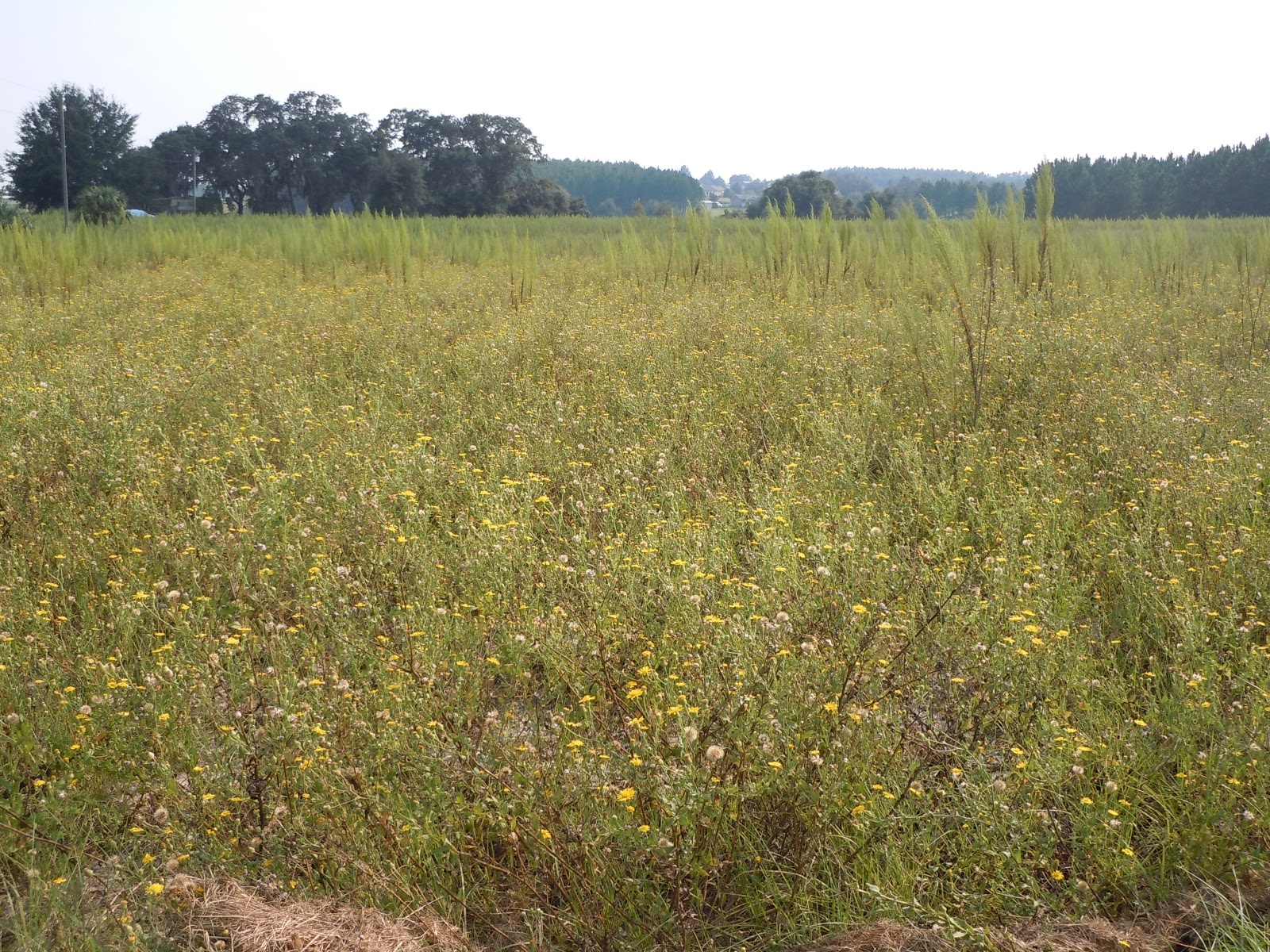
Broad fields of coastal-plain golden-aster bloom in early autumn.

Simply Living
October 3, 2011

Some things are so common, they become unnoticeable.

Blue skies are like that. When I moved to sunny Florida from overcast Cape Cod, I was constantly aware of the continual brightness. Every day I'd awaken to find rays of sunshine streaming through my windows. Although I was initially awed, after about a year of living in the Sunshine State the novelty of one brilliant day after another began to fade. Bit by bit, my mindset adjusted. I stopped being keenly aware of the sky above and began to take daily doses of brightness for granted.

"It's another picture-perfect day!" someone might say. "Oh, yeah," I'd respond matter-of-factly, glancing upward. "So it is."

The same thing can happen with wildflowers.

It took me about a week of driving past large fields of golden-aster before I realized the land I was passing was bursting with blooms.

During early autumn in Central Florida, huge expanses of coastal-plain golden-aster are flowering. The small, daisylike blossoms are about an inch across, with about 20 dandelion-colored petals encircling a slightly darker center. Multiple flowers open atop ungainly 2- to 3-foot-tall woody stalks. While each bloom is a sweet little flower, the entire package — stalk, stem and blossom — is unimpressive and ordinary.

In my rural neighborhood, golden-asters cover acres of undeveloped land. They also appear in small clusters alongside roadways and mailboxes and in just about any other place where land is untended and weeds can grow.

The fact that golden-aster isn't a showy plant might contribute to its anonymity. Unlike larger, brighter or more unusual blooms, this humble flower is easy to miss. What isn't as easy to overlook is the plant's ability to dominate acreage. Once aware of its existence, you will notice these wildflowers everywhere.

There are three reasons that golden-aster has proliferated so successfully. It tolerates a wide range of conditions, it's extremely hardy and it has an effective method of dispersing seeds.

The plant does best in dry, sandy soil — the type found in pinewoods, oak scrub and disturbed areas. It likes sun but proliferates freely in shady habitats as well. Extremely moist locations are a no-no for this no-nonsense perennial. And when it comes to propagation, golden-aster has it down pat, dispersing individual seeds in its puffy, round seed balls through air as well as by contact. This plant rarely succumbs to disease or insect attacks, but it does attract a fair number of butterflies and moths, which find it a suitable source of larvae food.

With so much going for it, you'd think this herbaceous Florida native would be a must on any gardener's wish list. Think again. The plain truth is, despite its attributes, golden-aster isn't as attractive as other plants in the aster family. Demand is low, so few native plant nurseries carry it. Beauty sells. Anything less...not so much.

If, instead of golden-aster, I drove by acres of sunflowers, coneflowers or phlox, I bet it wouldn't have taken me a week to notice them. Then again, like the Florida sky so blue, over time even stunning flowers might have gone unnoticed.

We live in a world filled with splendor. To enjoy it, all we have to do is open our eyes to the ordinary as well as the extraordinary. Golden-aster may be a fairly nondescript wildflower, but when seen from a distance, it fills the land with a golden hue. Blatant beauty may sell, but subtle beauty survives, and if the landscape around my neighborhood is any indication, golden-aster is nothing less than a thriving survivor.

Monday, September 26, 2011

Do pears grow well in Florida? Ap(pear)ently, they do!

Old-fashioned Southern pear trees produce heavily even when neglected for years.


Simply Living
September 26, 2011

My son came back from a walk the other day with about a dozen old-fashioned Florida pears that he had picked in a nearby abandoned orchard. Although the tree had received no care for years, that didn't seem to affect its production. Dozens of hard, amber-skinned fruit still hung from its scrawny limbs.

Southern pear trees are like that. These small to medium-sized deciduous trees tend to resist disease, tolerate extended droughts and produce prodigious amounts of tan- to brown-skinned, white-flesh fruit. Of the many old-fashioned varieties, Orient, Kieffer and pineapple pears stand out as staples of many longstanding Florida homesteads.

Because I wasn't sure which variety Tim had picked, I contacted Brandy Cowley-Gilbert, owner of Just Fruits & Exotics nursery in the Florida Panhandle town of Crawfordville. After I described the pear's size, shape and texture, Cowley-Gilbert said my son had probably gathered a bunch of Orient pears.

"The Orients have been around for a long time," she said. "They are a round, large pear that ripens in the fall and grows well in Central Florida."

Cowley-Gilbert said pears, persimmons, blackberries, muscadine grapes and pomegranates are fruits that will survive despite years of neglect.

"These are long-lasting fruits that can still produce 40 to 50 years after they were planted," she said.

The people who planted the pears that Tim picked probably didn't grow them as a table fruit. The softball-sized Orient and other "sand pears" (the name for a class of Chinese pears traditionally grown in the South) are a cooking fruit used in baking and canning and to make chutney, preserves and even wine.

The main thing I do with them — and what I did with the cache Tim gave me — is to make a simple pear sauce.

After washing and slicing the pears into small chunks (skin and all), I put them into a pot with about two inches of water, cover and cook over high heat. When they begin to boil, I turn the flame down and simmer, stirring occasionally, until the chunks slip off a fork when pierced. At that point, I turn off the heat and let the soft fruit cool a bit before pureeing in a food processor and adding a sprinkling of ginger, cinnamon and a little sweetener.

I like to use plant-based, no-calorie stevia as a sweetener, but at times I've used maple syrup, agave and honey. I've also even eaten the pear sauce plain, allowing the fruit's natural sugars to do the job.

The day after I made the pear sauce (devouring most of it when still warm!), I realized that I'd overlooked one of the pears. The forgotten pear was too small to make into sauce by itself or to use in baking, so I decided to cut off wedges as if it were an apple to eat fresh with a chunk of sharp cheddar cheese.

Even though most people use the sand pear for cooking, I found its fresh flavor satisfying. The pear was crisp and slightly sweet and made a perfect "pairing" with the cheese. Orient pears resemble the round Asian pears sold in the produce department of grocery stores, but the flesh's texture is somewhat harder.

It's too bad that a fruit that used to be a mainstay of most Florida homesteads and diets has become unfamiliar. Most Floridians are probably unaware that certain varieties of old-fashioned pear trees not only grow but thrive in a climate best known for its citrus.

"Pears are truly one of the easiest and trouble-free fruits the homeowner can grow," Cowley-Gilbert said.

If the quick disappearance of my pear sauce is any indication, they are also one of the tastiest.

Monday, September 19, 2011

Little-known persimmons are worth discovering

Two plump tanenashi persimmons, similar in shape and taste to commercially grown hachiya persimmons, ripen on the tree as temperatures cool.

Simply Living
September 17, 2011

Ralph just came in from picking persimmons. One of our trees is loaded with fruit, and my husband aims to pluck the ripe fruit before the bugs, raccoons, possum and fox discover them.

For a long time, eating ripe persimmons has been one of our autumn rituals, but it wasn't always that way. Like most Americans, I knew nothing about persimmons. I didn't grow up having a bowl of them on my breakfast table like bananas. When I felt like a snack, I didn't bite into them like apples, nor did I bake with them or make them into puddings. Persimmons did not have a place in my life until the 1990s, shortly after we moved to Lake County.

In those days, the bright-colored orange fruit native to China held great promise as a replacement crop for frost-killed citrus groves. Throughout Florida's central and northern regions, farmers planted extensive orchards of the small, deciduous trees in the hope that the fruit, which is a dietary mainstay of many Asian countries, would catch on with U.S. consumers.

We planted our first trees around that time, and while interest in persimmons shifted slightly, it never caught on to the extent growers hoped it would. These days, persimmons are more familiar to American shoppers than they were 20 years ago, but to many, they remain a mystery. That's too bad because these shiny-skinned edibles are well worth sampling for their sweet flavor and high nutritional value.

Low in calories and with zero fat, persimmons are a great source of dietary fiber as well as being high sources of vitamins A and C. Unfortunately, discovering the fruit's many attributes involves actually tasting one, and to do that, consumers have to learn when a persimmon fruit is ripe enough to eat.

There are hundreds of different types of persimmons but only two varieties — hachiya and fuyu — are commercially available. Of the two, hachiya is most common in grocery stores. That's regrettable because unlike fuyu, which is edible when its flesh is either soft or hard, hachiya is palatable only when its flesh has attained a jellylike consistency. One bite into an unripe hachiya stops most people in their tracks, preventing them from ever trying a persimmon again.

Both fuyu and hachiya persimmons are orange fruits that ripen from September through December. The skin on tomato-shaped fuyus is thick, similar in texture to that of an apple. I like to eat them like apples, one bite at a time, until I get to the throwaway stem. My husband approaches the fruit differently. He cuts off the tough outer skin and slices the flesh into wedges. I like his method, and if I weren't so lazy, I'd prepare them that way too.

Hachiya persimmons are also orange-colored but their skin is thinner than the fuyu and their shape is acorn-like instead of round. They are also an astringent fruit, while fuyu persimmons have no astringency at all.

When ripe, hachiya flesh has the consistency of a ripe plum. If you bite into the fruit before then, the inside of your mouth will feel like it is full of fuzz, the way it does when you take a bite of an unripe banana.

Because I'm an impatient eater, I often approach a hachiya like a plum. I pick it up and bite into it, skin and all. It's a sloppy affair, with slippery flesh and dripping juices threatening to drop onto clothes. Ralph's technique is much neater and more civilized. He cuts off the stem end and uses a spoon to scoop out the sweet-flavored, soft insides.

The tree that Ralph just finished picking is a tanenashi persimmon, similar to the commercially grown hachiya. Assuming he can stay ahead of the creepy crawlers and wildlife nibblers, that one tree should provide us with enough fruit to eat fresh, freeze and share with family.

But you don't need your own tree to discover the wonders of this little-appreciated-in-America fruit. Next time you're at your grocery, buy one and take it home. If it is a fuyu persimmon, go ahead and give it a try, but if it is a hachiya variety, exercise patience. Wait until the flesh is plum-soft before taking a bite. Once you've tried it, don't be surprised if eating persimmons becomes one of your autumn rituals as well.

Monday, September 12, 2011

Love plants? Love mysteries? You'll love this series!

Susan Wittig Albert has written more than 100 books, including the popular China Bayles mystery series.

Simply Living
September 12, 2011

I love a good novel, especially one with interesting characters, a captivating story line and the ability to teach me something new about topics I hold dear. That's why I'm a fan of the plant-themed China Bayles Mystery Series by Texas Hill Country author Susan Wittig Albert.

In each of the series' 18 novels, main character China Bayles (big-city lawyer turned small-town herb-shop owner) solves murders through a combination of botanical know-how, deductive skills and legal reasoning. Each novel expands my plant knowledge while providing a welcome and entertaining literary escape.

I don't like slasher stories, psychological thrillers or books that frighten or give me nightmares. Neither do I abide by unnecessarily sad or uncertain endings. None of that happens in a China Bayles mystery. When I open the pages to one of Albert's books, I am guaranteed a good time. I enter a world I can relate to — a small town inhabited by a quirky but lovable cast of characters who struggle to overcome common, everyday problems. Albert's stories end happily, a feature I covet in both books and movies.

Although each of the series' 18 mysteries is an independent read, the stories always begin in the fictional Texas Hill Country town of Pecan Springs, where the lives of the main characters progress from one book to the next. That makes each installment like a visit with old friends. With a turn of the page, I "catch up" with a cast of imaginary people who have come to feel like they're almost real.

Front and center is the proprietor of the Thyme and Season Herb Shop, China Bayles, and Bayles' best friend, business partner and mystery-solving sidekick Ruby Wilcox. She's a New Age maven with a propensity for right-brain thinking that contrasts nicely with Bayles' more left-brained, practical approach.

Bayles' love interest, Mike McQuaid, is a former detective who, following a work-related injury, trades his badge for stints as a private investigator and university educator. Other recurring characters include McQuaid's son, Wilcox's daughter, various local business owners and relatives and friends of the main characters. The entire package is sprinkled with humor and includes satisfyingly unpredictable endings.

Albert published her first China Bayles novel, "Thyme of Death," in 1992. It must have been around that time when I chanced upon it on the shelves of my local library. I quickly devoured that book and have been gobbling up new installments ever since. Fortunately, Albert has written more than 100 titles under her own name and various pen names. With the exception of 2002, there has been a new China Bayles novel annually. The most recent release, "Holly Blues," came out in 2010. I'm never left hungry for long.

In addition to each story's underlying botanical theme, every chapter is anchored by herbal quotes, proverbs, plant-related recipes and gardening folklore. In "Indigo Dying" (2003), I read about the different cloth-coloring properties and histories of various plants, along with recipes for herb quiche and frijoles de olla (beans in a pot).

In "Rosemary Remembered" (1995), the folk saying that headed Chapter 12 — "To learn humility, one must weed the Thymes" — struck me as particularly relevant. At the end of each novel, a list of pertinent resources provides motivated readers with ways to continue learning about plants mentioned in the stories.

One of the few things I enjoy more than getting lost in a book is learning more about one of my favorite subjects. With Albert's help, I'm able to broaden my botanical knowledge in a memorably entertaining way.

Monday, September 5, 2011

It's hard to love a plant like Spanish needle

Spanish needle's small, daisylike flower (left) turns into a sphere of barbed seeds that latch on to anything they touch.

Simply Living
September 5, 2011

I'm not a fan of Spanish needle (Bidens alba), but I feel like I should be because this white, flowering relative of asters has many of the attributes I look for in a plant.

It attracts wildlife (especially bees and butterflies), has both edible and medicinal properties and is a Florida native. However, it also produces an abundance of hard-to-remove, needlelike black seeds that are frustratingly difficult to remove from any article of clothing that happens to brush against them.

I've been battling Spanish needle on our property for 20 years, and I haven't won yet. Right now, I'm looking out my office window at an explosion of these leggy weeds that have sprung up in what is supposed to be my ginger garden.

I'm trying to like them. I really am. But two decades of disdain is difficult to overcome.


I'm not alone in my feelings. Ever since people have been in contact with Spanish needle, they have made up names to express their impression of a plant so intent on propagating itself through contact that its seeds adhere like barbs to anything they touch. Among its many monikers are beggartick, hairy beggar's tick, shepherd's needle and devil's sticktight.

Spanish needle is a perennial wildflower with a deep taproot and small, daisylike blooms. It likes hot weather, it's drought- resistant and it's not particular about soil conditions. It isn't fussy about location, either, growing well in both sun and shade. Although its white, yellow-centered flowers are tiny (about an inch across), each 3-foot-tall plant has multiple blooms.

When flowering, it is innocuous and even beneficial. Some people might even say the flowers are pretty. I wouldn't be among them, but flying insects must think so. The plant attracts numerous butterflies, bees, wasps and dragonflies and is the larval host for the emerald moth, dainty sulphur and Florida duskywing butterflies.

After flowers fade and seeds develop, the Spanish needle earns its negative nicknames. A single plant can produce more than 1,000 two-toothed seeds, each with the annoying ability to cling tightly to hair, fur or cloth. Its hitchhiking habit serves the plant well, enabling it to do what plants need to do: spread out and reproduce. I have to admit it is extremely successful at those goals.

On one level, I appreciate Spanish needle. It is a hardy, resilient, determined plant. It has managed to survive — even thrive at times — in places it is not wanted. Those very traits, however, also make me dislike it. I can't tell you how many times I've struggled to dislodge the barbed seeds from my husband's white socks or from the hem of any skirt I've been foolish enough to wear when I've walked in the woods.

There's a strong movement afoot to embrace native plants. Spanish needle may be a Florida native that bees and butterflies adore, but that doesn't mean I have to like it or want it in my yard. Neither should I feel guilt each time I fantasize about ripping out every last specimen (as if that were even possible!).

No, some plants' negative features simply overshadow their attributes. That's how it is for me and Spanish needle. Sometimes, the best weeds are the ones growing elsewhere